Notice: This article was created with AI.
What’s it about?
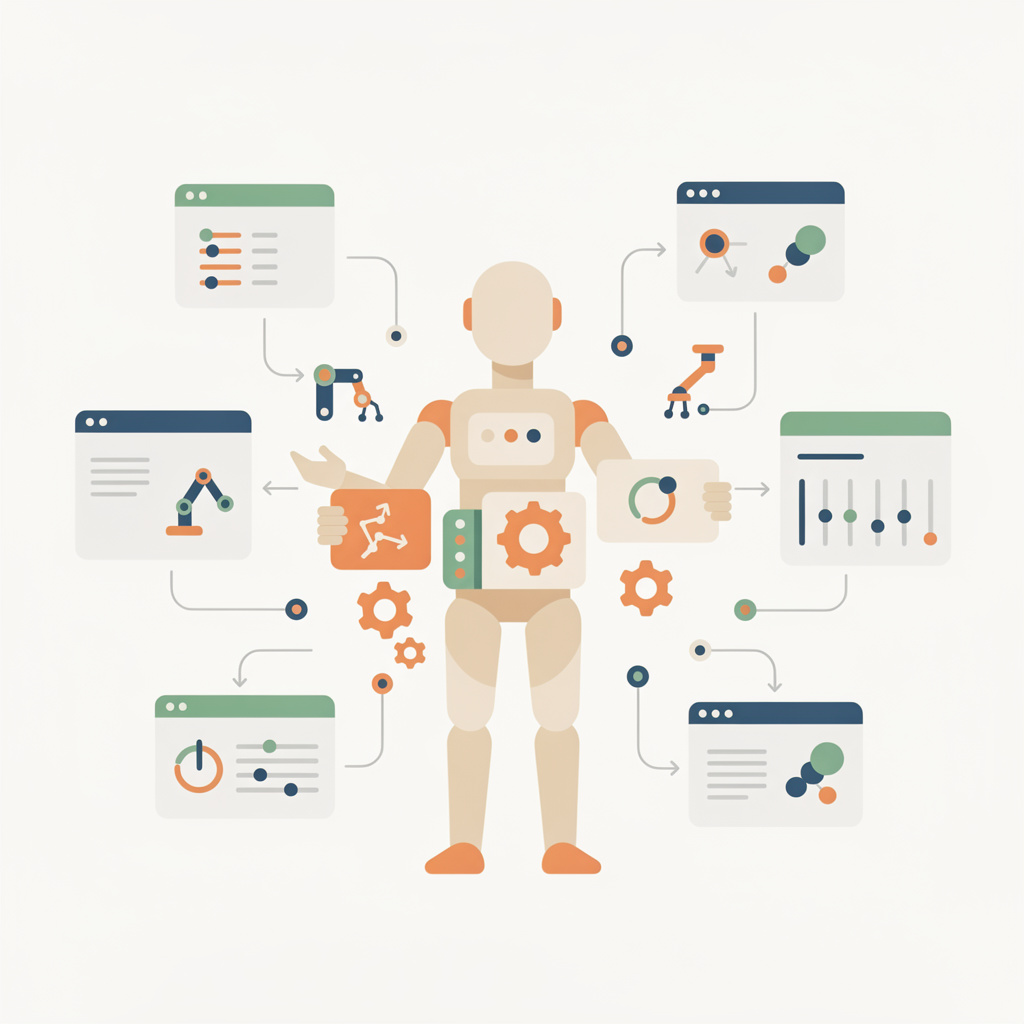
Companies are increasingly relying on Robotic Process Automation to automate time-intensive, repetitive workflows. The technology relieves human employees of routine tasks and enables them to focus on more strategically important activities. Modern RPA solutions are increasingly integrating artificial intelligence and machine learning, enabling the processing of complex, unstructured data.
Background & Context
The current generation of RPA tools goes far beyond simple macro automation. They combine traditional process automation with advanced technologies such as computer vision and machine learning. This fusion is often referred to as hyperautomation and allows even more demanding business processes to be automated.
A central aspect of implementation is the distinction between different bot types: Attended bots work in collaboration with humans and require their interaction, while unattended bots operate fully autonomously and respond to events. Most modern platforms offer low-code environments with drag-and-drop functionality, enabling less technically proficient users – so-called citizen developers – to create automations.
One challenge remains the lack of standardization: each vendor uses proprietary file formats, which means solutions cannot easily be transferred between platforms. This makes extensive proof-of-concept testing essential before making a final decision. Additionally, integration into existing enterprise systems still requires manual adjustments and careful planning.
The providers at a glance. Four platforms dominate the market. They differ less in what is technically possible than in target audience, depth of governance and pricing model.
| Provider | Strength | Typical audience | Entry price (as of April 2026) |
|---|---|---|---|
| UiPath | Market leader in enterprise automation; AI-supported document processing (“Document Understanding”), assistant features in Studio | Large organisations with many processes | around €420 per month |
| Automation Anywhere | Cloud-native, deep integration of generative AI, large marketplace with more than 1,200 ready-made bots | Enterprise, cloud-oriented | usage-based, not published |
| Blue Prism | Governance and compliance: central administration, complete audit trails | Regulated industries – banking, insurance, pharmaceuticals | not published |
| Microsoft Power Automate | Tight integration with Microsoft 365; workflows can be described in natural language via Copilot | SMEs and departments in Microsoft environments | from €15 per user and month |
How to choose from these. The question is rarely “which tool is best” but “which one fits our situation”. If you already work in Microsoft 365 and want to automate individual departmental processes, Power Automate gets you moving fastest without setting up an IT project. If you want to standardise many processes across departmental boundaries, you end up with UiPath or Automation Anywhere. And if you work in a regulated industry where every bot action has to be provable, Blue Prism is the more likely fit – there, traceability is the core of the product, not an add-on.
Prices are list prices. Two of the four providers publish none at all. In any case the real costs rarely sit in the licence but in rollout, process analysis and bot maintenance – and that comes round every time an interface the bot operates is changed.
What does this mean?
- RPA tools enable significant efficiency gains through the automation of repetitive processes across various business areas
- The integration of AI capabilities extends the range of applications to complex tasks involving unstructured data
- Low-code approaches democratize automation and enable business users to create workflows
- Companies must pay attention to compatibility with existing systems and individual requirements when selecting a tool
- A thorough evaluation through testing phases is indispensable due to proprietary formats and varying feature sets
Sources
RPA Software: Die besten Tools für Robotic Process Automation (Computerwoche)
Top RPA (Robotic Process Automation) Tools (CIO.com)
Robotic Process Automation (RPA) (GBTEC)
RPA & Low-Code: Prozessautomatisierung (Mendix)
This article was created with AI and is based on the sources cited above as well as the language model’s training data.
Further Reading
GPTs, Skills, Plugins, Agents – Who Offers What, and What’s Actually Worth It?