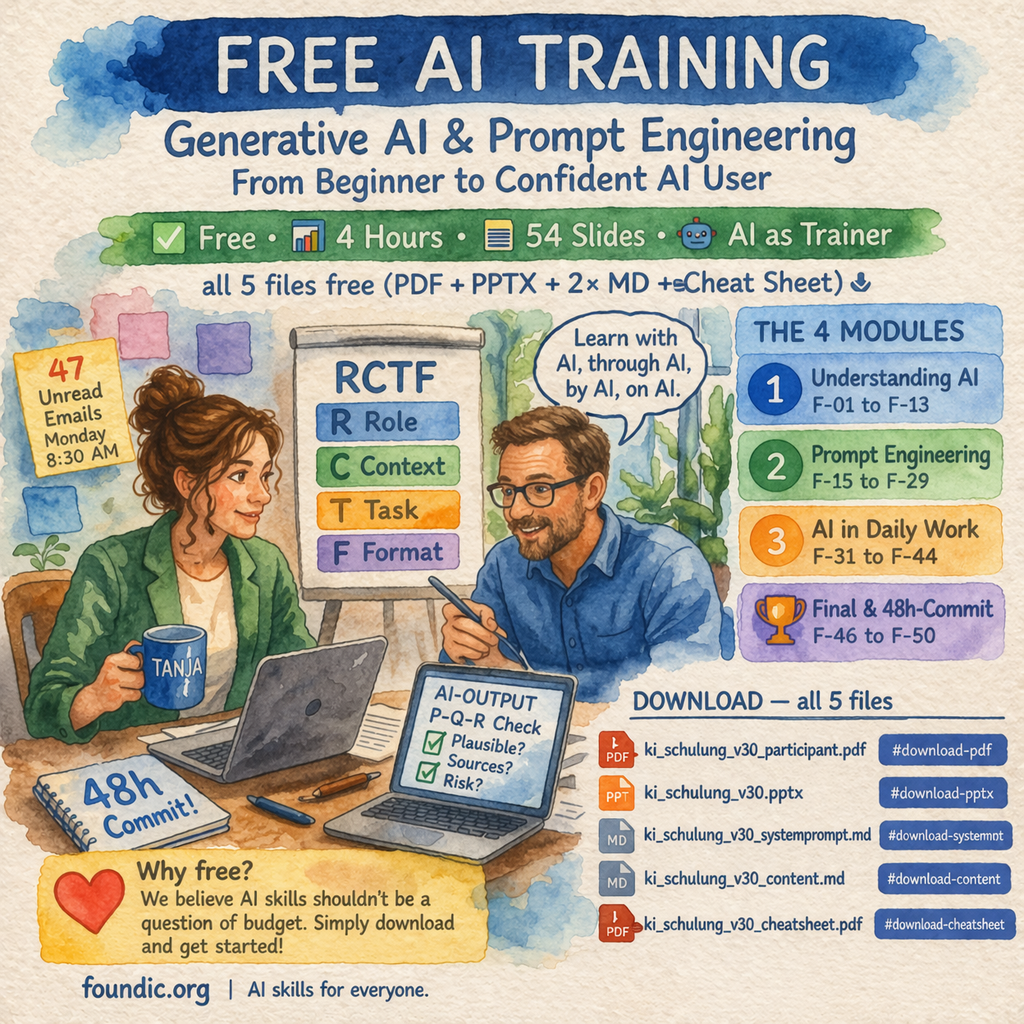
Generative AI is no longer a technology of the future – yet most people are still using it at a fraction of its potential. Prompts that are too vague, the wrong tools, no real system: the result is frustration instead of time saved. This training changes that – in four hours, from zero to confident.
With this article, foundic.org publishes its first complete AI training course: Generative AI & Prompt Engineering – From Beginner to Confident AI User. All materials are free and available for download.
What if your trainer is the AI itself?
Other trainings explain AI. This one can be moderated by an LLM acting as a slide-anchored trainer. The slides remain the visual anchor – the language model handles explanations, quiz sessions, and prompt feedback. You don’t just learn about AI; you learn with AI and through AI. A free account with Claude or ChatGPT is all you need.
| Traditional AI Training | This Training |
|---|---|
| 💸 €500–2,000 per person | ✅ Completely free |
| 📅 Fixed schedule, group format | ✅ Any time, 1-on-1 coaching |
| 👨🏫 Human trainer explains AI | ✅ LLM moderates the training |
| 🔄 Exercises in a separate tool | ✅ Learn and practice in the same chat |
| 📋 Generic content for everyone | ✅ Your real tasks from minute one |
| 📬 Materials sent by email afterwards | ✅ All files available for immediate download |
Who is this AI training for?
No technical background required. This training is designed for:
- Beginners with no AI experience – those who tried ChatGPT, gave up after two weeks because results weren’t convincing
- Knowledge workers in communications, finance, HR, marketing, executive assistance, and project management
- Internal multipliers and trainers looking for a ready-to-use introductory course for their team
- Organisations that want to build AI competency without expensive external training
Those who already work with AI daily will still find structuring value in the RCTF framework and the P-Q-R quality check.
What will you learn in this training?
The training is a 4-hour individual coaching session, structured into three modules plus a closing section. No lectures, no slide-reading – you start prompting live on your own tasks from minute one.
🔷 Module 1 – Understanding AI (Slides F-01 to F-13)
The difference between generative and invisible AI, which of the five major tools (ChatGPT, Claude, Gemini, Perplexity, Copilot) fits which situation, why AI sometimes hallucinates — and how to spot it. Three widespread AI myths are examined and debunked. The module closes with a six-question knowledge check.
🔷 Module 2 – Prompt Engineering (Slides F-15 to F-29)
The core of the training. You learn the RCTF framework — four building blocks (Role, Context, Task, Format) that turn any vague prompt into a precise instruction. Also covered: re-prompting as a professional method, making AI-generated text sound authentic, a data privacy traffic light for public chatbots, the EU AI Act in brief — and the P-Q-R quality check for systematically reviewing any AI output for plausibility, sources, and risk.
🔷 Module 3 – AI in Daily Work (Slides F-31 to F-44)
Three use cases with live exercises: writing (emails, reports, social media), research & analysis (a two-stage Perplexity–Claude workflow), brainstorming (20 ideas in 5 minutes, perspective shifts, action plans). Plus a mini case study with Bernd’s complete AI workflow, a reference card on common mistakes, and the full loop: RCTF → Execute → Re-Prompt → P-Q-R.
🔷 Closing (Slides F-46 to F-50)
Your personal 48h commitment: which task, which tool, which QA level — specific and binding. Five take-aways for home. A look ahead at AI trends 2026: agents, multimodality, personalised AI.
What you’ll be able to do after the training
- Write a complete RCTF prompt – for any task, in under 3 minutes
- Systematically review AI outputs using P-Q-R before using them
- Choose the right tool for the right task
- Protect sensitive company data – without giving up AI
- Use re-prompting as a professional method, not a workaround
- Recreate Tanja’s Monday: meeting summary in 3 minutes, proposal in 5, research in 20
The red thread: Tanja and Bernd
Two fictional characters accompany you through all 54 slides: Tanja, communications manager at Nordlicht AG, facing 47 unread emails on a Monday morning — and Bernd from finance, who almost presented a hallucinated revenue figure in a board meeting. Their stories make every abstract AI concept immediately tangible.
How to start the AI-guided training
What’s included in the download?
📊 1. The Slides – PDF and PPTX
- PDF (Participant Version) – recommended for the LLM coaching workflow. No trainer notes, opens in any browser, works on mobile.
- PPTX (Trainer Version) – for human facilitators or those who want to customise content. All trainer notes in the presenter view. Requires PowerPoint or LibreOffice.
🤖 2. The System Prompt (ki_schulung_v30_systemprompt.md)
Instructs the LLM to act as a slide-anchored trainer. Contains behavioural rules: strict slide order, limited response length when drifting, and a requirement to always return to the current slide. Note: this file contains no training content – only the LLM’s behavioural instructions.
📚 3. The Training Content (ki_schulung_v30_inhalt.md)
All 54 slides as a structured LLM reference: slide objective, core message, example or question, key takeaway — plus a “Do not drift” block with typical digression risks per slide. Upload this together with the system prompt into the same chat.
📄 4. The Cheat Sheet (ki_schulung_v30_cheatsheet.pdf)
A single A4 page for after the training: RCTF at a glance, P-Q-R as a checklist, five common mistakes with solutions, tool matrix, data privacy traffic light. Print-ready or digital.
Quick start: launching an LLM-guided session
For self-study with slides only, the PowerPoint is sufficient. For the LLM-guided version, you also need the two Markdown files. The PDF works well as a parallel reference on a second screen.
- Open Claude, ChatGPT, or Gemini in a new chat.
- Upload both Markdown files – first
_systemprompt.md, then_inhalt.md. - Type “Start” – the LLM takes over and begins with slide F-01.
- Open the slides PDF alongside in your browser, or the PPTX in PowerPoint.
- Keep the cheat sheet handy for your first week of practice.
Note: A free account is generally sufficient to get started. Upload behaviour and daily limits may vary by platform and model version.
Usage and Licence
- ✅ Personal use – free and unrestricted
- ✅ Internal, non-commercial training – free, attribution to foundic.org appreciated
- ✅ Redistribution – permitted with attribution to foundic.org
- ✅ Adaptation and customisation – permitted for internal purposes with attribution
- ⚠️ Commercial use – requires prior approval from foundic.org
Download – all five files, free of charge
We believe AI competency should not be a question of budget. This training is and will remain free — no registration, no newsletter sign-up, no strings attached.
| File | Format | Download |
|---|---|---|
| Slides – Participant Version 54 slides without trainer notes · approx. 1 MB |
⬇ Download | |
| Slides – Trainer Version 54 slides incl. all trainer notes · approx. 345 KB |
.pptx | ⬇ Download |
| System Prompt (LLM Trainer) Behavioural rules for the AI system · approx. 22 KB |
.md | ⬇ Download |
| Training Content (54 Slides) Internal reference for the LLM · approx. 132 KB |
.md | ⬇ Download |
| Cheat Sheet Single A4 reference page, print-ready · approx. 7 KB |
⬇ Download |
Frequently Asked Questions
Do I need any technical background?
No. All you need is a browser and a free account with one of the supported LLM services.
What is the difference between PowerPoint-only and LLM-guided use?
In the PowerPoint-only format, a human trainer runs the session – all cues and knowledge-check feedback are in the slide notes. In the LLM-guided format, the language model takes over: it reads the Markdown files, guides through the slides, explains in its own words, and gives direct feedback on your prompts — all in the chat.
What happens if the LLM goes off-script?
The system prompt contains explicit anti-digression rules – the LLM may answer with at most 2–3 sentences and must return to the current slide. Each slide note also contains a “Do not drift” block. In practice this works well in most setups, though results may vary by model.
Can I adapt the training for my team?
Yes. The PPTX is fully editable. The Markdown files can also be customised. Both are explicitly permitted for internal, non-commercial use.
May I use these materials within my organisation?
For internal, non-commercial training: yes, with attribution to foundic.org. For commercial use, please get in touch first.
We’d love to hear from you
This training is version 1.0 – and we want it to keep improving. We welcome all feedback:
- 🗨️ How was your experience? Did the LLM moderation work well?
- 🛠️ What could be improved? Content, structure, slides, pacing?
- 💡 What training would you like to see next? AI in Finance? AI for HR? Advanced Prompt Engineering? Automation with AI agents?
Leave a comment below – every piece of feedback feeds directly into the next version. And if this training helped you: share it with colleagues who haven’t yet dared to try AI. That’s exactly who we built it for.
Version: v30 | Date: March 2026 | Licence: Free for personal and internal non-commercial use with attribution to foundic.org
Category: Training | Duration: 4 hours | Format: LLM-moderated individual coaching | Files: PDF (Participant) · PPTX (Trainer) · 2× Markdown · Cheat Sheet