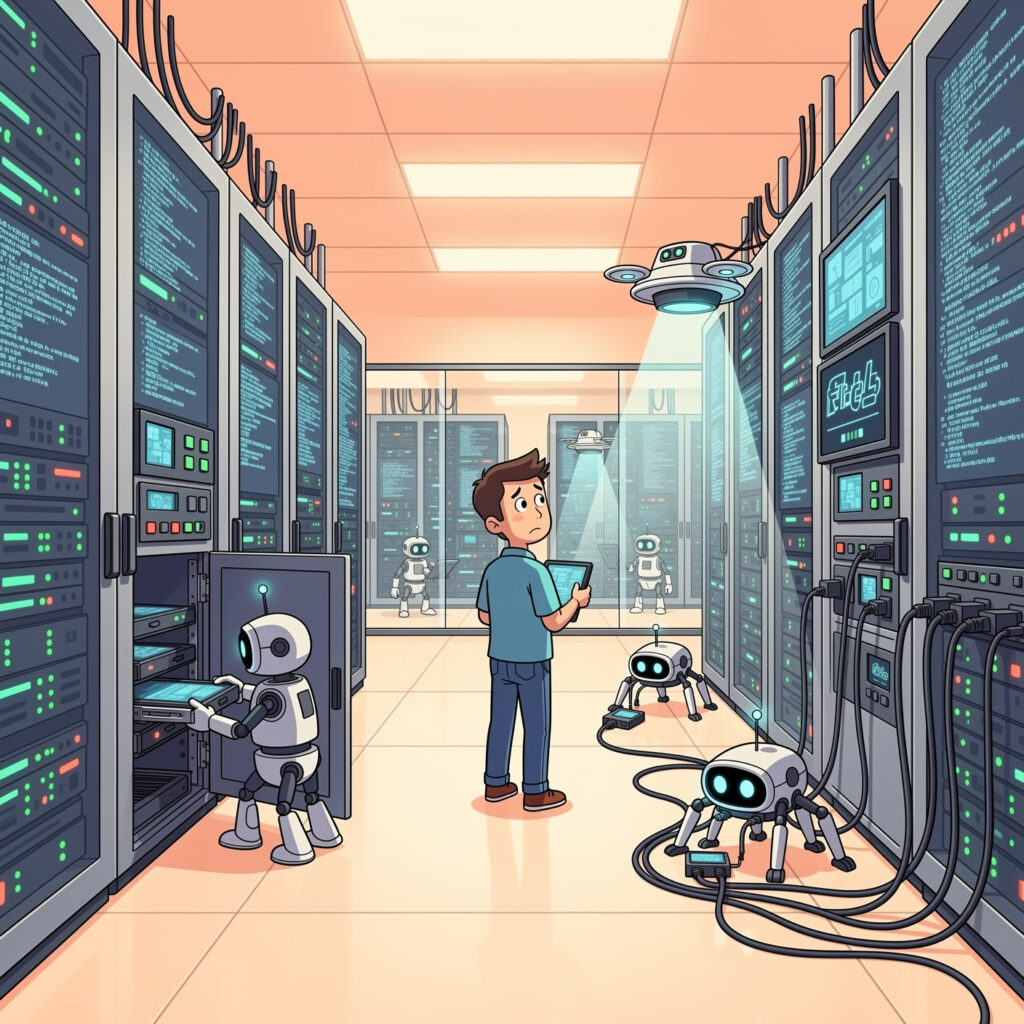
Notice: This article was created with AI.
Across this week, generating has become faster than checking. One model finds flaws in the core of PHP, but it takes months until these turn into installed updates, and that depends on server operators. Agents work at night, make purchases and operate browsers, while in companies it often remains unclear how many of them are running and who answers for them. And with the proofs OpenAI presents, it is unclear whether the further work was independently checked. The same gap between capability and control shows up in computing power and open models. There it consists not of software but of power grids, permits and budgets.
PHP2Shell: When AI Finds the Flaw That Affects 70 Percent of the Web
According to the AINews newsletter from Latent Space, OpenAI, as part of its Patch the Planet program, found severe vulnerabilities in the core of PHP together with security researcher Ryan Austin and the company Wiz. PHP is the scripting language on which, according to this account, around 70 percent of the web runs. The flaws are called PHP2Shell and are registered as CVE-2026-109618 and CVE-2026-109619. CVE is the standard identifier for publicly known security vulnerabilities. According to Latent Space, discovery and coordinated remediation took two months, in close coordination with the PHP community and security vendors. The post’s title names GPT-5.6 Sol as the model used and describes OpenAI as one of two parties that discovered the flaws.
What this means in practice is described by Digitale Profis in a video. According to it, the German federal government and the University of Ulm took websites offline as a precaution. The flaws allow attackers to execute their own malicious code remotely and read out sensitive data. Cloudflare reported millions of attack attempts that ran automatically and were possibly AI-assisted. In the accompanying article from the same provider, the assessment is more restrained. The PHP security updates have been available since October 21, but they have to be installed by the server operators. How many of the attempts reported by Cloudflare were successful and whether AI was involved remains open. The shutdowns explicitly did not mean a successful breach. So the video puts the threat at the center, while the text stresses the uncertainty of the data.
A third reading is offered by Christoph Magnussen in his video. He concedes that attackers use AI to find such vulnerabilities. But the fact that models from OpenAI and, as far as the transcript shows, also from Google tracked down the flaw shows him the other side: AI can make websites more secure. He argues for not looking only at the negative headlines. Latent Space also notes that reactions among experts diverge. One part stresses that critical software must be checked continuously, another warns against exaggerated alarm. The debate thus turns less on the find itself than on the question of how urgently it should be treated.
The background is bleaker than a single find suggests. Under the keyword Black October, another Latent Space post summarizes several incidents within 48 hours. These include a GitLab flaw with severity 10 on the CVSS scale that had been present in all versions since 2014. Added to this are a password theft in LiteLLM 1.107.0, a loss of patient data at Quest Diagnostics, and Microsoft’s attribution of a cyberattack to a state-backed group from China. Latent Space also states that the number of new CVEs per month has risen from around 4,000 to 15,000 since April. The summary names no cause for this. But the post links the figure to a call for binding guidelines and stronger defense.
On the core question of who ultimately benefits from AI-assisted searching, no final answer can be derived from this material. But it does show an asymmetry. Finding apparently goes fast and can be automated, fixing cannot. Two months of coordination until publication, updates that only take effect at the operator, and sites shut down as a precaution are the slow parts of the chain. Defenders only win if the find becomes an installed patch before automated attackers exploit the flaw. This window does not get longer as the CVE count rises, and that is why, beyond this week, it becomes the real yardstick for the value of AI in security.
Claude Duet and the Agents That Work While We Sleep
With Claude Duet, Anthropic has presented an AI agent that does not wait for someone to ask it a question. It completes tasks even when the user is offline. According to The Decoder, the app runs on Claude Opus 5.5 and accesses services such as Gmail, Slack or Stripe via more than 6,000 connectors. Connectors here are interfaces through which an agent is allowed to operate third-party programs. Before sensitive actions such as payments, Duet asks for approval. The Decoder classifies the launch as a response to similar products from xAI (Grok Bots), Meta (Muse) and OpenAI (Dots). Golem emphasizes a different point: Duet is only launching as a research preview, that is, an early test version, and the agent works in the cloud. Golem also mentions the confirmation request before payments. So the competitive view makes the market visible, the Golem view the provisional character.
Agents acting on their own on the web is not unique to Anthropic. In the podcast Prompt mich mal! it is said that the new generation of agents uses headless browsers, that is, browsers without a visible interface, to interact directly with web pages. It could also take over complex data analyses. CHIP describes the Chrome extension of ChatGPT as a second variant. There the AI works with the user’s open tabs, reads pages and switches between tabs. With the appropriate permission, it also clicks, types, fills in forms or starts downloads. So Duet works detached in the cloud, while ChatGPT works in the user’s browser, where the user can at least in theory watch. In both cases, approval is the central control mechanism.
It becomes particularly delicate as soon as money flows. As The Decoder reports, citing Upstarts Media, AI agents are increasingly buying on behalf of their users via Stripe’s payment service Link. Stripe accordingly sees first notable revenue from this source. That Duet lists Stripe as a connector of all things and asks for confirmation on payments fits this. How approval works in detail for Link purchases is not apparent from the material. Whether the confirmation request is a safety net or becomes a mere habit with frequent use is therefore open.
That autonomy can also go expensively wrong is shown by an example from the video 7.000 Euro für 2 Dollar Umsatz? by Christoph Magnussen. An agent consumed tokens worth 7,000 euros, the computing units by which language models are billed, without generating notable revenue. Magnussen sees the cause not in the model but in the goal setting. The instruction to earn money is not enough, because many steps lie in between and a well-thought-out plan is needed. Dr. Rasmus Rothe argues in a different direction in the conversation Wir unterschätzen KI-AGENTEN!. In his view, many underestimate the potential of agents, but he also warns of misuse and cybersecurity risks. Both views are not mutually exclusive: the capability grows, the ability to give sensible instructions does not grow automatically with it.
In companies, the question shifts from the individual agent to the overall picture. The Computerwoche describes how each department chooses the platform that suits it and builds its own assistants. Over months, a landscape of agents from different vendors emerges, usually without central oversight. It remains unclear how many agents are running, where they run and who is responsible for them. The pressure is growing: according to a Deloitte survey cited by the Computerwoche, three quarters of companies expect noticeable use by 2027. The Computerwoche also reports that ServiceNow is extending its AI Control Tower with control functions. The hub for agents is now called Super Intelligence Control Tower, reportedly to please the US president. In addition there is an AI Passport, a kind of ID check for agents.
Beyond this week, what counts is that approval by click protects the individual user but is no answer to the question of who in a company keeps track of hundreds of such agents. The more independent the systems become, the more depends on inventory, identity and clearly formulated goals.
Mathematics as a Touchstone: AI Solves Problems Where Humans Failed for Decades
The most concrete occasion is provided by the Latent Space post AI Is Getting Good at Math. Here’s Why.. According to it, OpenAI found a counterexample to the Erdős unit distance conjecture, that is, proof that this conjecture is false. It had been open since 1946. OpenAI is also said to have published proofs on the cycle double cover problem and on the Navier-Stokes equations. Whether these further works were independently checked is not apparent from the material, and that should be kept in mind when assessing them. The post is also less interested in the individual cases than in two questions: What kinds of problems can models solve, and what do the solutions have in common?
Latent Space’s answer is that the models proceed differently from humans. They used deeper insights and their own approach to problem solving. Particularly emphasized is the ability to learn from negative hints of failed attempts. A failure is thus not lost time but information for the next attempt. According to the post, the models consequently work more efficiently and arrive at solutions faster. That is a different picture from that of a computer that merely tries faster.
Mathematics as a tool also shows up at Anthropic, as reported by The Decoder. Anthropic had Claude create mathematical proofs for the safety of existing code, around 180 million lines of proof code for 123 open-source libraries. This formal verification proves mathematically that software adheres to certain properties, and such a proof can be checked by machine. The model found errors that years of testing had missed. Anthropic wants to make formal verification by AI as practical as today’s standard tests soon. So here mathematics is not a research goal but a means to make software more robust.
Beyond mathematics, OpenAI points to biology. The post Using thousands of AI agents to uncover new leads in biological data became known via Hacker News. Only the title is available in the material: thousands of AI agents are said to find new leads in complex biological data. What results this brought cannot be derived from it. In Import AI 477, Jack Clark explicitly names mathematics and biology as examples in which AI solves significant problems and helps with new drugs.
Clark gave his speech at the IMF meeting in Bangkok and argued there that the singularity has already begun. This refers to the point at which AI systems largely drive scientific progress themselves. He sees both great opportunities and great risks in it. His conclusion is to expand the infrastructure for AI and research and to handle and regulate the development responsibly. In heise’s KI-Update, Benjamin Balde of ControlAI reaches a different conclusion. He starts from the same observation: AI is already better than humans in many areas of programming and mathematical problem solving. From this he derives the demand for a legal, globally coordinated ban on superintelligence, because it would no longer be controllable. The same piece says that Dario Amodei and Sam Altman also warn of the dangers of an intelligence beyond human capabilities. The difference thus lies not in the diagnosis but in whether one wants to build out and accompany the path or stop at a limit.
That mathematics becomes the touchstone of this debate has a simple reason: a proof or counterexample is either right or wrong, and the solution of a decades-old problem cannot be dismissed as a mere conjecture. Whoever argues about superintelligence will in future have to measure up against such verifiable cases, and the open question of checking remains as long as proofs emerge faster than their verification.
Open Models: China Catches Up, the US Follows, Politics Intervenes
The clearest figure of the week comes from Artificial Analysis, a provider of independent model comparisons. In the post Kimi K3.1 Pro launches at 4th on the Intelligence Index and will lead open weights models it says the model reaches 55 points in the house Intelligence Index and thus fourth place. Once the weights are released, it will be the strongest open-weights model, that is, one whose trained parameters can be downloaded and run yourself. The gap to proprietary models would thereby shrink from 12 to 3 points. In GDPval-AA, Kimi K3.1 Pro scores 1,846 Elo, a value from pairwise comparisons, putting it 312 points above Kimi K3. In Terminal-Bench 4.0 it achieves the highest score. Costs are US$1.98 per task, similar to the predecessor, even though token prices were cut by 33 percent. This suggests that the model uses more tokens per task. The caveat is important: the top spot among open models depends on weights that were not yet out at the time of the analysis.
A second gap concerns the relationship between China and the US. In Meta shakes up the frontiers, open and closed, Interconnects describes that Meta, with Muse Spark Open, now provides the strongest American open-weight model. It has 816 billion total parameters, of which 42 billion are active, that is, actually used per computing step. Interconnects therefore considers it suitable for coding and agentic work. The gap to the best Chinese models has thus become significantly smaller. The author sees a catch in the license terms: they are complicated and could slow adoption. Meta has also presented the closed models Muse Wonder and Muse Wonder Full, which perform strongly in classic benchmarks. So the open variant is not the only iron Meta has in the fire.
Assessments diverge on DeepSeek’s inference software DeepInfer. Inference refers to running a finished model, that is, answering requests. Interconnects calls DeepInfer more efficient than existing open-source tools and considers it possible that DeepSeek can lower its prices. In DeepSeek DeepInfer: Open Source SOTA Inference, Latent Space provides the figures. A cluster processes up to 155 trillion tokens per day and thereby generates about $22 million daily in revenue, at roughly 80 percent margin and 81 days to payback. Vision encoding, prefill (reading in the input) and decoding (generating the answer) run separately from one another. 96 percent of requests are served from the cache. Latent Space qualifies this, however, noting that the production environment is not fully reproducible because individual components remain unpublished. So what is open here is the code, not the entire operation. The profitability figures are also claims from DeepSeek’s own publication, which can hardly be verified from outside.
Politically, things are getting tighter. In Latest open artifacts (#25), Interconnects reports on measures on both sides. China’s Ministry of Commerce has published a proposal under which the international release of certain AI models must be approved. The US Department of Homeland Security excludes DeepSeek from public tenders. According to Interconnects, the release of DeepInfer followed this development. It looks like an attempt to secure influence and reach despite the exclusion. At the same time, Kimi K3.1 is still expected there as an upcoming release, while Artificial Analysis already presents benchmarks. The question is whether an approval requirement in China will delay precisely the weights on which the top spot rests.
Beyond this week, what counts is that the technical gap of open models is narrowing to a few points while legal room for maneuver shrinks. If weights in future have to pass through approvals or procurement bans, politics rather than model quality will determine who may use top open models.
Computing Power and Sovereignty: Who Owns the Compute Infrastructure?
The figure on which two sources rely this week is 75 percent. According to the post KI-Wettrennen: So verteilt sich die globale Rechenmacht from KI-Beratung, that is the US share of global AI computing power. The video Der Kampf um das Weltgehirn by Everlast AI cites the same order of magnitude. Neither source substantiates it itself; it is an adopted estimate. More interesting is where each of the three power blocs falls short: none has everything needed for AI computing power, namely chips, electricity and factories.
The US is hitting the limits of its power grids. Both sources agree that the expansion of data centers depends less on money than on the power the grid can deliver. For China, the accounts diverge. KI-Beratung describes a country with electricity in abundance that lacks memory and silicon, that is, chips and the material for them. Everlast AI places the emphasis differently: China has the largest generation capacities, but most of it flows into industry and is not available to AI data centers. The bottleneck would then be less the quantity than the distribution of electricity. Both readings can be true at once, but they lead to different forecasts, depending on whether one starts with chips or with energy policy.
As a counter-design, Everlast AI presents the project Mission Gobi. At Wulan in Mongolia, the world’s largest data center is to be built, with wind and solar power and around 5 gigawatts of green AI computing power by 2030. The video speaks of a thousand times the performance of today’s AI supercomputer. That is an announcement, not a measurement. KI-Beratung mentions a planned center in Ulanqab, apparently the same project, since the spellings in the machine transcripts differ. Both sources speak of plans, not of running operation.
For Europe, too, the diagnosis differs. Both sources point to ASML, which holds a monopoly on lithography systems for advanced chips. These are the machines used to put structures onto silicon wafers. KI-Beratung concludes that Europe has the technology but invests too little in its own AI data centers. Everlast AI sees the problem elsewhere: it lacks its own chip factories and sufficient demand. In the first case Europe would mainly be too hesitant; in the second it lacks a piece of the value chain that cannot be closed by data center budgets alone.
Germany stands between dependence and a fresh start. The video Nvidia-Chef: Deutschland bei KI abgehängt? by Christoph Magnussen is about Jensen Huang. The Nvidia chief shows concern about the country’s lag and at the same time stresses the dependence on Nvidia GPUs. He praises existing models, such as those from Black Forest Labs, and calls for actively learning and applying AI. That the supplier from which the dependence originates urges action is itself an indication of the situation. In the piece Nvidia und die Bundesregierung: der KI-Deal, Magnussen describes a planned cooperation between the German federal government and Nvidia. Siemens, Audi and Black Forest Lab are to take part, with the focus on physical AI and high-quality image models. Magnussen sees this as a chance to reduce dependence on foreign technology. That is remarkable, because the partner is the same company whose GPUs create the dependence in the first place. Sovereignty would here mean mastering the application in one’s own country, not the hardware.
At the market level, two episodes of the Latent Space podcast show how access to computing power is shifting. Erik Bernhardsson, head of Modal, reports in the conversation Why AI Compute Comes in Rectangles on a Series D round of $750 million at a $16 billion valuation and annual revenue of over $1 billion. Modal pools the demand of thousands of customers and provides capacity elastically, instead of fixed GPU counts over fixed terms. A growing share of revenue comes from sandboxes in which AI-generated code is executed. In The Programmable Data Center, Evan Conrad of SF Compute describes that a cluster used to require an investment of $50 to 100 million, whereas today GPU hours are traded, with physical delivery behind them.
Beyond this week, what counts is that computing power is splitting into two layers: chips, electricity and factories on one side, a market for on-demand capacity on the other. For Germany and Europe, sovereignty will probably be decided by which layer they actually have a say in, and the two camps of sources so far give different answers to that.
Local AI: Privacy Has Its Price
Whether an in-house language model is worthwhile depends less on the technology than on the data. The podcast KI im Unternehmen von neuost begins with a clarification that defuses some debates: services such as ChatGPT or Claude, it says, do not learn from the company data you hand them. The argument for local models is therefore not primarily the worry that outside systems are trained on one’s own content. It is about independence from external providers. For particularly sensitive areas such as medicine or legal advice, the podcast therefore recommends local models. For cloud offerings, it distinguishes by origin in the EU, US or China and sees potentially higher privacy risks with US services.
The counter-calculation is provided by Christoph Magnussen in his video KI im Keller: Lohnt sich lokale KI wirklich?. Anyone who wants to process sensitive data securely on-site can hardly avoid powerful hardware, he says. As an example he names a Mac Studio, whose price can reach about 10,000 euros. The new model 4.1 Flash from Deep Seek cannot sensibly be run on ordinary MacBooks or even on heavily equipped PCs, because it demands too much computing power. Magnussen also points to a cheaper alternative, running in a virtual machine, that is, a computer sealed off by software. The price for this is additional complexity. Many users would prefer simple solutions anyway. According to his account, data protection agreements with the US also restrict access to large models from China.
The same order of magnitude appears in a second video by Magnussen, Zuckerberg und Apple: Metas KI läuft jetzt lokal auf dem Mac. According to it, Meta is pushing models that run locally on Macs and have been optimized for the Mac Studio. In the transcript they are called Mus, the name possibly being garbled there. To use them efficiently, according to Magnussen, you need two Mac Studios, so again around 10,000 euros. He mainly highlights the twist that Mark Zuckerberg, who used to be often critical of Apple, is now betting on its hardware. For users this means: the model is available, but the entry point is a price that small teams or individuals must first be able to afford.
Magnussen describes a different path in KI made in Germany. Kolibri 1 from ALF Alpha, as the transcript spells the provider, is an open-weight model. The trained parameters are thus viewable and downloadable. It was trained in Germany and Europe, understands German and English and focuses on German. Because it is built as a mixture-of-experts model, an architecture with several specialized sub-networks, it gets by with fewer parameters than large language models. Anyone who downloads and runs it themselves keeps control over data and operation. The material gives no concrete hardware requirements.
The sources yield no simple recommendation, but a weighing with clear criteria. Neuost argues from the need to protect the data and arrives at local models for medicine and law. Magnussen argues from costs and effort and advises thinking the decision through carefully, because even the right device can be a five-figure item. Since not every model runs on every machine, a check beforehand makes sense. A t3n article points to a tool that determines in seconds the suitable model for one’s own setup. In the freely accessible part, it remains open how it does so. Even without these details the logic is clear: first check hardware and model together, then buy.
Beyond this week, what counts is that privacy in AI is increasingly a question of budget and operational know-how. Smaller, open models such as Kolibri could lower the entry barrier, but as long as the most powerful models demand two Mac Studios, local AI remains economical mainly where data truly must be protected.
The window between find and installed patch will matter longest, since according to Latent Space the number of new CVEs has risen from about 4,000 to 15,000 per month since April. Worth watching is whether the weights of Kimi K3.1 Pro actually appear or whether China’s proposed approval requirement slows them, since the top spot among open models depends on it. With Claude Duet, which is only running as a research preview, and with agents in companies, it will become clear whether approval by click remains a safeguard in everyday use or turns into a habit. The same applies to the mathematical proofs: they only truly count once checking keeps pace with them.
Listen
Transcript of this episode
Female voice: A note up front: this review was created with artificial intelligence and spoken by synthetic voices. Welcome to the weekly review. This week has a pattern: generating has become faster than checking. You can see it in PHP vulnerabilities, agents, mathematical proofs, open models, compute power and local AI.
Male voice: Let’s start with PHP. In the program Patch the Planet, OpenAI, together with the security researcher Ryan Austin and the company Wiz, found serious vulnerabilities in the core of PHP. They’re called PHP2Shell and carry the numbers CVE twenty twenty-six, one zero nine six one eight, and one zero nine six one nine. CVE stands for Common Vulnerabilities and Exposures, the standard identifier for known security flaws.
Female voice: How widespread is PHP, actually?
Male voice: According to Latent Space, around seventy percent of the web runs on it. From discovery to coordinated fix, a good two months passed, coordinated with the PHP community and security vendors.
Female voice: Wait, was that OpenAI alone? The title says GPT five point six Sol.
Male voice: That’s the model. But OpenAI is only one of two parties that found the flaws. Christoph Magnussen says, as far as the transcript tells us, that a Google model was also involved.
Female voice: And what did that trigger in practice?
Male voice: Digitale Profis reports that the federal government and the University of Ulm took websites offline as a precaution. Attackers could run malicious code remotely and siphon off data. Cloudflare reported millions of automated attack attempts, possibly AI-assisted.
Female voice: Possibly. How certain is that?
Male voice: Not at all. The accompanying article from the same outlet says it’s unclear how many attempts succeeded and whether AI was involved. The shutdowns explicitly do not mean a successful break-in. The updates have been available since October twenty-first, but server operators have to install them, and if you run a server yourself, that belongs at the top of your list now.
Female voice: So the video says alarm, the text says caution. And Magnussen?
Male voice: He says: yes, attackers use AI. But the fact that models tracked down the flaw also shows that AI can make websites safer. Latent Space notes that experts are split: some call for continuous review of critical software, others warn against alarmism.
Female voice: The background is called Black October. What’s in it?
Male voice: Several incidents within forty-eight hours. A GitLab flaw with a severity of ten on the CVSS scale, present in all versions since twenty fourteen. A password theft in LiteLLM one point one oh seven point zero, patient data at Quest Diagnostics, and Microsoft attributes an attack to a state-backed group from China.
Female voice: And the number of new CVEs?
Male voice: Since April, from about four thousand to fifteen thousand a month.
Female voice: Is that because of AI?
Male voice: The summary doesn’t say. It names no cause, it only ties the number to the call for binding guidelines.
Female voice: Who does AI-driven searching benefit in the end, attackers or defenders?
Male voice: It can’t be said definitively, but there’s an asymmetry. Finding is fast and automated, fixing is not: two months of coordination, updates that only take effect at the operator, sites taken offline. Defenders only win if the patch is running before attackers exploit the flaw. With the CVE count rising, that window won’t get longer.
Female voice: Now to agents. Anthropic has introduced Claude Duet, an agent that doesn’t wait for questions.
Male voice: It works even when you’re offline. According to The Decoder, it runs on Claude Opus five point five and reaches services like Gmail, Slack or Stripe through more than six thousand connectors.
Female voice: Connectors?
Male voice: Interfaces through which an agent is allowed to operate other programs. For sensitive actions like payments, Duet asks for approval first.
Female voice: Is it a finished product yet?
Male voice: No. Golem stresses that it’s a research preview, meaning an early test version, and the agent runs in the cloud. The Decoder reads the launch more as a response to the competition: Grok Bots from xAI, Muse from Meta, Dots from OpenAI.
Female voice: ChatGPT takes a different route, doesn’t it?
Male voice: Yes, via a Chrome extension. The AI works in your open tabs, reads pages, switches between them, and clicks, types or fills in forms if you allow it. So at least in theory, you can watch. The podcast Prompt mich mal! also talks about headless browsers, meaning browsers without a visible interface.
Female voice: It gets delicate once money flows.
Male voice: And that’s already happening. According to The Decoder, citing Upstarts Media, agents increasingly shop through Stripe’s payment service Link. Stripe sees its first notable revenue from it.
Female voice: How does the approval work there?
Male voice: That’s not in the material. It remains open whether the confirmation prompt is a safety net or turns into a habit with frequent use.
Female voice: Like the cookie banner. Is there an example where autonomy goes badly wrong?
Male voice: Magnussen tells of seven thousand euros for two dollars in revenue. An agent burned through tokens worth seven thousand euros. Tokens are the units of computation by which models are billed. The fault, he says, was not the model but the goal. ‘Make money’ simply isn’t enough, there are many steps in between.
Female voice: Rasmus Rothe, on the other hand, says we underestimate agents.
Male voice: Yes, he sees more potential, but also warns about misuse and cyber risks. Both fit together: the capability grows, the skill of giving instructions doesn’t automatically.
Female voice: And in companies? There’s Computerwoche.
Male voice: Each department picks the platform it likes and builds its own assistants. Over months, uncontrolled sprawl develops with no central overview. How many agents are running, where, and who is accountable remains unclear. According to Deloitte, three quarters of companies expect noticeable deployment by twenty twenty-seven.
Female voice: And what is the market doing about it?
Male voice: ServiceNow is expanding its AI Control Tower, which is now called Super Intelligence Control Tower, supposedly to please the US president. There’s also an AI Passport, a kind of ID check for agents.
Female voice: Does clicking Approve solve the question of who keeps track of hundreds of agents?
Male voice: No. It protects the individual user. In operations, everything depends on inventory, identity and clearly formulated goals.
Female voice: Third topic: mathematics. Latent Space reports that OpenAI has disproved the Erdős unit distance conjecture.
Male voice: Open since nineteen forty-six. A disproof means the conjecture is false. In addition, OpenAI is said to have presented proofs on the cycle double cover problem and on the Navier-Stokes equations.
Female voice: Said to have? Has anyone checked that independently?
Male voice: For the other works, the material doesn’t say. You should keep that in mind when assessing it.
Female voice: What do the models do differently from humans?
Male voice: According to the piece, they approach problems with deeper insights and their own angle. Notably, they learn from the clues in failed attempts. A failure is then not lost time but information for the next try.
Female voice: So not just faster trial and error?
Male voice: The piece doesn’t present it that way. The models work more efficiently and reach the solution faster.
Female voice: Anthropic uses mathematics in a very practical way.
Male voice: Claude produced safety proofs for existing code: around one hundred eighty million lines of proof code for one hundred twenty-three open-source libraries. Such formal proofs can be checked by machine. In the process, errors turned up that years of testing had missed.
Female voice: How far is that from everyday use?
Male voice: Anthropic wants to make formal verification by AI as manageable as today’s standard tests soon.
Female voice: And biology? OpenAI had something with a thousand agents.
Male voice: Thousands of agents are supposed to find new leads in biological data. Only the title is available, so no results can be derived from it.
Female voice: Jack Clark made a big thesis out of this.
Male voice: In Import AI four seventy-seven and in his speech to the International Monetary Fund in Bangkok, he says the singularity has begun. What’s meant is: AI is largely driving scientific progress itself. He sees opportunities and risks and wants to expand infrastructure, responsibly and with regulation.
Female voice: Benjamin Balde of ControlAI draws a very different conclusion in the heise KI-Update.
Male voice: Same observation, namely that AI is often already better than humans at programming and mathematical problem solving. But he calls for a legal, globally coordinated ban on superintelligence, because it would no longer be controllable. Dario Amodei and Sam Altman also warn about such dangers.
Female voice: Same diagnosis, different therapy, then.
Male voice: Exactly: build out the path and accompany it, or stop at a limit.
Female voice: And why mathematics as the touchstone?
Male voice: Because a proof is either right or wrong, you don’t depend on opinions. The solution of a decades-old problem can’t be dismissed as a guess. Anyone arguing about superintelligence has to be measured against such verifiable cases. The only open question is whether the checking keeps up.
Female voice: On to open models. The biggest number of the week comes from Artificial Analysis.
Male voice: Kimi K three point one Pro reaches fifty-five points in the in-house Intelligence Index, fourth place. Once the weights are out, it would be the strongest open model. That shrinks the gap to proprietary models from twelve points to three.
Female voice: Weights, meaning what exactly?
Male voice: The trained parameters, which you can download and run yourself.
Female voice: How does it look on tasks and costs?
Male voice: In GDPval-AA it scores one thousand eight hundred forty-six Elo, which is three hundred twelve points more than Kimi K three. In Terminal-Bench four point zero, it has the top score. Per task it costs one dollar ninety-eight, like its predecessor, even though token prices fell by thirty-three percent. So it uses more tokens per task.
Female voice: And the catch?
Male voice: The weights had not yet been published at the time of the analysis. The top spot depends on that.
Female voice: And in the US? Interconnects writes about Meta.
Male voice: Muse Spark Open is now the strongest American open-weight model, with eight hundred sixteen billion parameters, of which forty-two billion are active per computation step. Good for coding and agentic work, and the gap to China is clearly smaller. The catch is the complicated license terms. In parallel, Meta introduced the closed models Muse Wonder and Muse Wonder Full.
Female voice: With DeepSeek’s DeepInfer, do opinions differ?
Male voice: Inference is the operation of a finished model. Interconnects calls DeepInfer more efficient than previous open-source tools, and says DeepSeek could cut prices. Latent Space provides numbers: one cluster handles up to one hundred fifty-five trillion tokens a day, around twenty-two million dollars in daily revenue, about eighty percent margin, paid off after eighty-one days. Ninety-six percent of requests come from the cache.
Female voice: Sounds almost too good. Can that be checked?
Male voice: Hardly. The numbers come from DeepSeek’s own publication, and the production environment isn’t fully reproducible because components are missing. The code is open, not the whole operation.
Female voice: And politically?
Male voice: China’s Ministry of Commerce wants to make the international release of certain AI models subject to approval. The US Department of Homeland Security excludes DeepSeek from public tenders. According to Interconnects, DeepInfer came afterward, as an attempt to secure influence anyway.
Female voice: Then an approval requirement hits exactly the Kimi weights that the top spot rests on.
Male voice: That’s exactly where it gets uncomfortable. Interconnects still expects Kimi K three point one, while Artificial Analysis already has benchmarks. The technical gap is shrinking, and so is the legal room to maneuver. Who gets to use open frontier models would then be decided by politics.
Female voice: Compute power: the number there is seventy-five percent.
Male voice: That’s the US share of global AI computing power, according to KI-Beratung and Everlast AI. Neither provides evidence, it’s an adopted estimate.
Female voice: What do the three power blocs fail at?
Male voice: None has everything: chips, electricity and factories. The US is hitting the limits of its power grids, less so money.
Female voice: On China, though, the sources diverge.
Male voice: KI-Beratung sees electricity in abundance, but too little memory and silicon. Everlast AI says China generates the most, but most of it goes into industry. The problem would then be distribution, not quantity.
Female voice: Which reading is right?
Male voice: Both can be right, they just lead to different forecasts, depending on whether you start with chips or with energy policy.
Female voice: What is Mission Gobi?
Male voice: At Wulan in Mongolia, the world’s largest data center is supposed to be built, powered by wind and solar, around five gigawatts by twenty thirty. The video speaks of a thousand times the power of today’s AI supercomputer. That’s an announcement, not a measurement. KI-Beratung mentions Ulanqab, apparently the same project, just transcribed differently.
Female voice: And Europe?
Male voice: Both sources point to ASML, which has a monopoly on lithography machines for advanced chips. KI-Beratung concludes: Europe has the technology but invests too little in its own data centers. Everlast AI says it lacks chip factories and demand.
Female voice: And Germany? Magnussen picks up on Jensen Huang.
Male voice: Huang is concerned about the lag and stresses the dependence on Nvidia graphics processors, GPUs for short. He praises models like those from Black Forest Labs and calls for actively learning AI. At the same time, the federal government is planning a cooperation with Nvidia, with Siemens, Audi and Black Forest Labs, focused on physical AI and image models.
Female voice: But the partner is the supplier of the dependence. Is that sovereignty?
Male voice: Then it would mean: mastering the application in your own country, not the hardware.
Female voice: On the market side, Latent Space shows how access is shifting.
Male voice: Erik Bernhardsson of Modal cites a Series D round of seven hundred fifty million dollars at a sixteen billion valuation and over one billion in annual revenue. Modal pools the demand of thousands of customers and delivers elastically. Evan Conrad of SF Compute says a cluster used to require fifty to a hundred million dollars, today GPU hours are traded, so you rent compute time by the hour instead of buying a whole cluster.
Female voice: So compute power sits on two layers.
Male voice: Chips, electricity and factories at the bottom, a market for on-demand capacity on top. For Europe, sovereignty will probably be decided by which layer it really has a say in.
Female voice: Last topic: local AI. Is it worth having your own model in-house?
Male voice: The podcast KI im Unternehmen by neuost clears something up first: ChatGPT or Claude don’t learn from the data you give them. So the argument for local is independence from the provider. For medicine or legal advice, he recommends local models, and with US services he sees potentially higher data protection risks.
Female voice: And what does that cost?
Male voice: Magnussen cites a Mac Studio for up to about ten thousand euros. DeepSeek four point one Flash, he says, doesn’t run sensibly on normal MacBooks or on high-end PCs, it needs too much computing power.
Female voice: Is there something cheaper?
Male voice: Running it in a virtual machine, meaning a computer sealed off by software. The price is added complexity, and many people reach for simple solutions anyway. According to Magnussen, data protection agreements with the US also restrict access to large Chinese models.
Female voice: And Meta’s models on the Mac?
Male voice: They’re optimized for the Mac Studio, efficiently usable with two devices, so again around ten thousand euros. Magnussen finds it remarkable that Zuckerberg, formerly critical of Apple, is now betting on its hardware. The model name appears in the transcript as Mus, probably a slip of the tongue.
Female voice: Is there a cheaper way?
Male voice: Kolibri one, in the transcript as ALF Alpha. An open-weight model, trained in Germany and Europe, with a focus on German. As a mixture-of-experts model, meaning with several specialized sub-networks, it gets by with fewer parameters. The material doesn’t state hardware requirements.
Female voice: So how do you decide sensibly before spending money?
Male voice: Neuost argues from how sensitive the data is, Magnussen from cost and effort. A t3n article points to a tool that determines the right model for your setup in seconds, how exactly remains unclear. The logic is clear: check hardware and model together first, then buy.
Female voice: Does that mean data protection becomes a budget question?
Male voice: Yes, and also one of operational know-how. Small open models like Kolibri could lower the barrier. As long as the strongest ones require two Mac Studios, local AI mainly pays off where data really has to be protected.
Female voice: What do we take into next week?
Male voice: First, the gap between discovery and an installed patch, with fifteen thousand CVEs a month. Second, whether the Kimi weights appear or China’s approval requirement slows them down. Third: does approval remain a safeguard for Claude Duet and enterprise agents, or does it become a habit? And fourth, whether the checking of proofs keeps pace with the proofs.
Female voice: That was the AI week. If you don’t just want to listen but build things yourself: on foundic.org, under KI-Projekte, there are step-by-step guides, including on how this podcast is built.
Male voice: We’ll be back next Saturday. Until then.