Notice: This article was created with AI.
What’s It About?
The PC landscape is changing fundamentally: alongside the classic processors CPU and GPU, a third computing unit is coming into use with the Neural Processing Unit. This component, developed specifically for artificial intelligence, is the heart of the new generation of PCs marketed as Copilot+ PCs. The NPU handles AI tasks directly on the device and promises both energy efficiency and speed advantages over conventional solutions.Background & Context
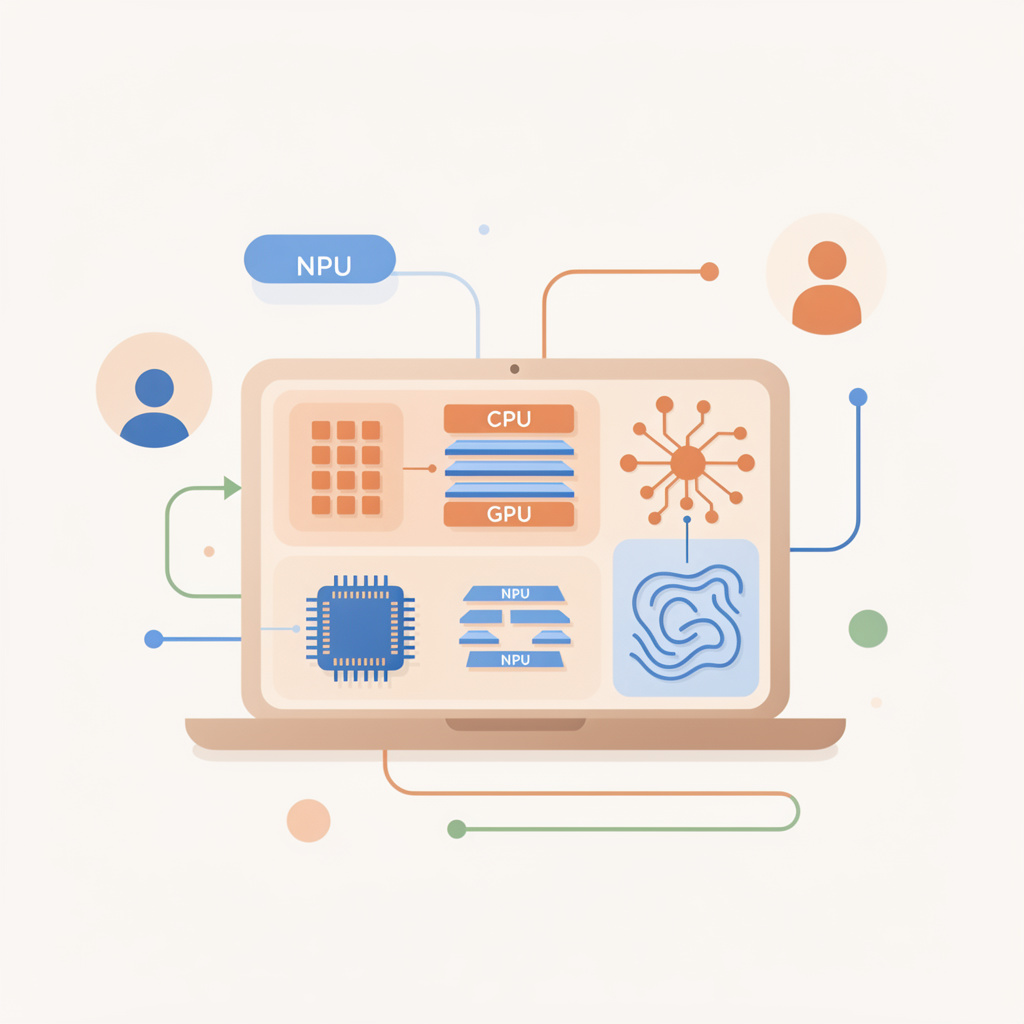
The three computing units divide the work in modern AI PCs according to a clear scheme: the main processor (CPU) continues to function as the central control unit for all basic system processes. The graphics unit (GPU) is responsible for parallel computations, especially in graphically demanding applications. The newly added NPU focuses exclusively on AI inference tasks such as pattern recognition or speech processing. For certification as a Copilot+ PC, Microsoft has defined concrete minimum requirements: the NPU must be able to deliver at least 40 TOPS (Tera Operations Per Second), that is, perform 40 trillion computing operations per second. In addition, 16 gigabytes of RAM and 256 gigabytes of SSD storage are required as basic equipment. Current processor generations from Intel and AMD already clearly exceed these specifications. The decisive advantage of the NPU lies in its energy efficiency: it consumes considerably less power than graphics processors in data centers and thus enables longer battery life. It also uses specialized computing units for complex matrix operations that are indispensable in the training and execution of AI models. Local processing on the device brings further advantages: faster response times, better data protection due to the absence of cloud transmission, and functionality even without an internet connection.What Does This Mean?
- New hardware architecture: The integration of NPUs establishes a three-pillar structure in PCs, in which each computing unit is optimized for specific tasks.
- Performance metric TOPS: The number of computing operations per second becomes the central comparison criterion for the AI performance of different devices.
- On-device AI: Through the local execution of AI functions directly on the PC, new application possibilities emerge without dependence on cloud services.
- Energy efficiency in focus: NPUs enable AI functions with significantly lower power consumption than GPU-based solutions, which is particularly relevant for mobile devices.
- Growing application ecosystem: Software developers are beginning to optimize their applications for the use of NPUs, which continuously expands the range of functions.
Sources
NPU, GPU, CPU – wer macht im KI-Notebook eigentlich was? (PC Welt) Copilot+ PC erklärt: Was bringt ein KI-Notebook (Allround PC) KI auf dem Gerät: NPU-Laptops, Copilot-PCs – Hype oder sinnvoller Performance-Boost? (Nereo) Inside the AI PC: CPU, GPU and the Rise of the NPU (Dell Blog) This article was created with AI assistance and is based on the listed sources as well as the language model’s training data.Further Reading: From Rule-Based Chatbots to Modern LLMs: How Machines Learned to Speak and Why It Matters Today