Notice: This article was created with AI.
What’s It About?
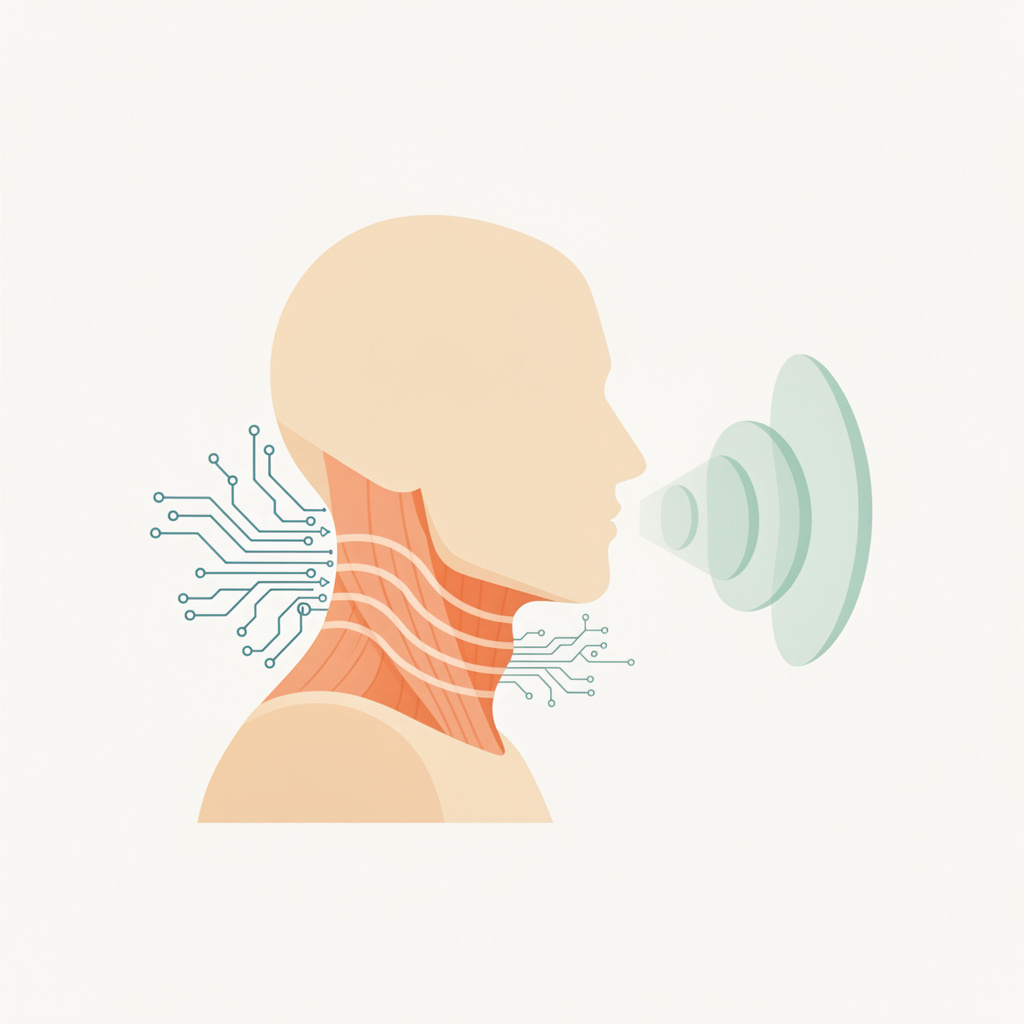
Scientists have presented an innovative technology that can translate silent muscle movements in the throat area into audible speech. The AI-based method was developed at POSTECH and is aimed in particular at people who have lost their ability to speak due to illness or injury. Unlike previous approaches, the system works by capturing fine muscle activity and converts it into synthetic voices with the help of AI algorithms.
The system first captures the movements of the neck muscles via sensors during a silent attempt to speak. These signals are then interpreted by an algorithm trained on comparison data. Particularly remarkable is the ability to create individual voice profiles, so that the synthesized speech resembles the natural sound of the person. Initial tests indicate that this approach surpasses established methods such as electromyography or electroencephalography in efficiency.
Background & Context
Research in the field of assistive speech systems has made considerable progress in recent years. While earlier technologies often relied on invasive brain implants or complex EEG setups, the new approach promises a less elaborate alternative. The technology uses machine learning to reconstruct linguistic content from the fine muscle contractions that arise when attempting to speak.
A decisive advantage lies in its robustness against ambient noise. In contrast to microphone-based systems, muscle capture also works reliably in noisy environments. This opens up not only medical applications for people with conditions such as ALS or after strokes, but also practical use cases in situations where silent communication is desired – for example in libraries, theaters, or sensitive professional contexts.
The development takes place in the context of a broader movement to use AI systems for restoring lost bodily functions. While other research projects focus on decoding brain signals, this approach relies on peripheral capture, which is potentially easier to implement and less invasive. The researchers’ long-term goal is to enable users to speak as naturally as possible, so that communication feels authentic and fluent.
What Does This Mean?
- People with speech loss due to conditions such as ALS, stroke, or larynx surgery potentially gain a new means of communication that approximates their own voice.
- In the future, the technology could serve as a non-invasive alternative to brain implants and thereby reduce the risks and costs of medical procedures.
- Applications beyond the medical field are conceivable, for example for silent communication in public spaces or in professions with noise exposure.
- The development demonstrates the growing potential of AI systems to interpret complex physiological signals and translate them into practical applications.
- Broad use still requires further refinements and clinical validations, but the initial results are encouraging.
Sources
Forscher entwickeln System, das stumme Muskelbewegungen in Sprache verwandelt (t3n)
Gelähmte Menschen sollen mit KI ihre Sprache zurück bekommen (Elektronikpraxis)
KI-Technologie ermöglicht lautlose Sprachwiedergabe (IT Boltwise)
KI ermöglicht Sprechen nach Schlaganfall (Tagesschau)
This article was created with AI assistance and is based on the listed sources as well as the language model’s training data.
Further Reading: AI Audio 2022 to 2026: Four Years in Which the Voice Lost Its Innocence