
It is just past midnight, and Marlene can’t stop staring at her screen. She’s a copywriter — freelance, for twelve years — and she has just done something she would have considered impossible a year ago: she threw a vague idea at a machine, “write me an opening about the history of the Viennese coffeehouse — melancholy, but not sentimental,” and got back a paragraph that sounds better than much of what she manages on a tired evening. Rhythm, word choice, that delicate ironic undertone. She is impressed. She is also a little unsettled.
Then she reads more carefully. In the middle of the text sits a sentence about a particular coffeehouse that allegedly opened in 1873, with an anecdote about a regular, a writer whose name rings vaguely familiar. She googles. The coffeehouse doesn’t exist. Neither does the writer. The anecdote is entirely invented, delivered in a tone of such matter-of-fact certainty that Marlene almost used it.
In that small moment — somewhere between admiration and suspicion — lies the entire great question of our time about artificial intelligence. Because what Marlene experienced is neither a user error nor an accident. It is the machine doing exactly what it was built to do — just not what we believe it does.

Why This Question Matters Now
Few technologies are discussed as much — and as contradictorily — as large language models (LLMs: the programs behind ChatGPT, Claude, or Gemini). Some see the birth of a new intelligence, perhaps the final step before a machine smarter than ourselves. Others see a clever sleight of hand that works primarily because we humans automatically attribute a thinking mind to any fluent language.
Both camps have good arguments. And both frequently talk past each other because they skip a prior question: what exactly are these machines? Only once you have at least a rough grasp of that can you meaningfully debate what they can do, what they cost, who they enrich and who they put out of work, and whether the trillions being invested in them right now are a smart bet or a collective hallucination.
This article takes you through both camps. No prior knowledge required — only a willingness to set aside a few cherished certainties along the way.
Not Artificial Brains, but Language Machines
Let’s begin with the most uncomfortable — and simultaneously most illuminating — thesis. It comes from Martin Warnke, a theoretical physicist by training and former professor of computer science and digital media at Leuphana University Lüneburg, who wrote a book with the unusual title Large Language Kabbala. His central claim: the best explainers of AI are not engineers but scholars of text — linguists, literary scholars, even mystics. Because LLMs are not artificial brains. They are thoroughly linguistic constructs.
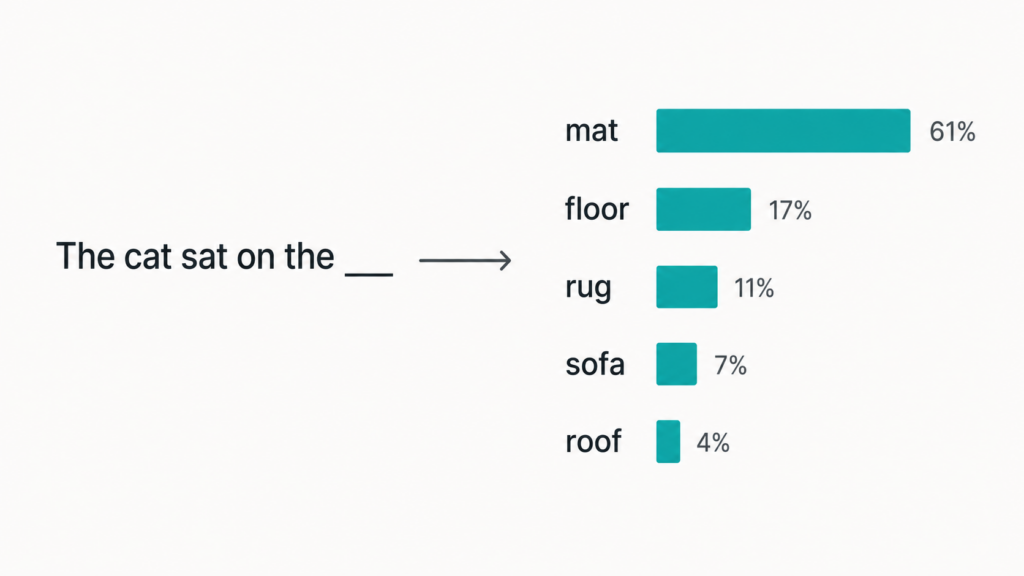
To understand what that means, you need to know how such a model works. An LLM breaks text down into tiny building blocks called tokens (word fragments or short character sequences — the smallest unit of processing in a language model). During training, it reads unimaginably vast quantities of human text and learns one single, astonishingly powerful ability: it estimates which token is most likely to come next. Nothing more. It is an autocomplete of superhuman sophistication — but at its core, that is exactly what it is: a probability calculation over language.
The intellectual root of this idea reaches far back. Warnke points to the American linguist Zellig Harris, who as early as the 1950s advanced a radical thesis: the meaning of a word can be read entirely from its distribution — from the company it typically keeps among other words. Meaning, intention, consciousness? Irrelevant to the analysis. Words that appear in similar environments are similar. Full stop. Exactly this principle sits inside every LLM today: it does not know the world; it only knows the statistical neighborhood relations of language.
The Stochastic Parrot
A group of AI researchers around Emily Bender and Timnit Gebru coined a phrase in 2021 that has stuck: the stochastic parrot (from Greek stochastikos, “based on conjecture”). A parrot imitates human sounds perfectly without understanding what it says. An LLM assembles linguistic forms into convincing sequences because it has learned how they typically combine — but with no connection to meaning whatsoever. The result is a flawless linguistic surface that inevitably creates in us the impression of a thinking interlocutor. The impression arises in us, not in the machine.
Why Marlene’s Invented Coffeehouse Wasn’t a Bug
Now Marlene’s late-night experience becomes explicable. The industry calls such freely invented claims hallucinations and treats them mostly as a teething problem: more data, better training, finer filters — it’ll sort itself out. Warnke disagrees fundamentally. Hallucinations, in his reading, are not a bug but an inevitable consequence of the architecture. A system that derives meaning exclusively from statistical language patterns and has no contact with reality simply cannot distinguish between true and false. It only distinguishes between more probable and less probable text continuations. An invented but plausibly worded coffeehouse is statistically just as correct as a real one. The machine has no way of knowing the difference.
What is missing is what cognitive science calls grounding — the anchoring of language in actual experience of the world. Humans learn language through the body: by touching, failing, feeling, in conversation with others. An LLM has no such anchor. Its concepts exist only as statistical relationships within its training text — a closed linguistic universe with no windows to the outside.
Warnke pushes this image to its limit with an analogy to the Jewish Kabbalah, the medieval tradition of textual interpretation. The Kabbalists treated sacred texts as a closed sign system whose hidden meaning could be unlocked through internal operations — letter values, permutations, layered strata. Meaning arose from structure and combination, not from reference to the outside world. In exactly the same way, says Warnke, LLMs generate the semblance of meaning from structure. The parallel is intended as a conceptual image, not a historical claim — but it hits a nerve.
The Counterargument: Maybe That’s Enough
At this point one might close the book and lean back, reassured: it’s all just a trick. But it’s not that simple, and an honest article must take the strong counterposition at least as seriously.
One elegant argument runs like this. The skeptics like to invoke the old saying: the map is not the territory. A model of the world is not the world. True — sometimes. But: a model airplane flies in the exactly same physical sense as a real airplane. Both generate lift according to the same aerodynamic principles. The model is smaller and made of different materials, but it really does fly. If an AI system produces a thought that is indistinguishable in its effects from a human thought — wherein precisely lies the categorical difference?
This argument does not claim that AI already thinks. It shifts the burden of proof: anyone who claims that human thought is categorically different must explain what exactly is different — and that explanation cannot stop at “it’s made of silicon rather than neurons.”
When Machines Solve Problems That Stumped Humans for Decades
The strongest argument of the optimists, however, is not philosophical but an already-delivered promise. AlphaFold, a system from Google’s subsidiary DeepMind, solved a biochemical puzzle that researchers had been working on for decades: predicting how a protein folds three-dimensionally from its amino acid sequence. Millions of such structures have since been predicted and made freely available — an accelerator for drug development and fundamental research.
The punchline: AlphaFold does not “understand” proteins in any human sense. It finds structures in data that allow empirically correct predictions. For the optimists, this proves that the skeptic’s question (“does the AI really understand?”) can simply be irrelevant to practical value. Similar things are showing up in materials science, where AI proposes new compounds before they exist in a laboratory, and in software development, where tools like Claude Code are already handling substantial portions of programming work today. Here, the efficiency gain is not a future promise — it’s measurable everyday reality.
The shared argument of the optimists runs: the skeptics are confusing the current state with a fundamental limit. Every claimed barrier — “AI can’t fold proteins,” “AI can’t code” — has either already fallen or is crumbling. That cannot be proven. But it deserves to be taken seriously.
Three answers to the question of what AI is
In the expert debate, roughly three camps can be distinguished — and it’s worth keeping them separate before we approach the question from a different angle:The skeptics (among them Warnke, Bender, and the linguist Noam Chomsky) regard language models as fundamentally limited. Between statistical pattern recognition and genuine understanding, they argue, lies an architectural barrier that no amount of additional data can overcome. It’s not a quantity problem — it’s a blueprint problem.
The emergentists (dominant in the major AI labs) place their hopes on emergence — the appearance of qualitatively new capabilities above certain scale thresholds — the hope that mere pattern recognition, at sufficient complexity, tips over into genuine reasoning. Weakness of the position: it is hard to falsify, since any future development can be booked as supporting evidence.
The world-model faction (prominently: Yann LeCun) finds language models impressive but a dead end. Real intelligence, they argue, requires a causal world model — an understanding of what actions in the world produce what effects. The future lies not in larger language models but in systems anchored in the physical world, through robotics if necessary.
The dispute cannot be resolved by more data. It is a genuine, open foundational question — and that is precisely why the next section approaches it from a different direction.
The Turn: Maybe It’s Not About Intelligence at All
And here comes what is perhaps the most important shift in the entire debate — one that resolves Marlene’s ambivalence and defuses the apparently irresolvable quarrel between skeptics and optimists.
As long as we ask “Is AI intelligent? Does it really understand?”, we remain trapped in a loop from which neither side can lever the other out. But what if that’s the wrong question? That is precisely the thesis of a remarkable self-correction that is increasingly shared by practitioners and humanities scholars alike: the actual breakthrough of language models is not neurophysiological but linguistic. It is not about the degree of intelligence — it is about language.
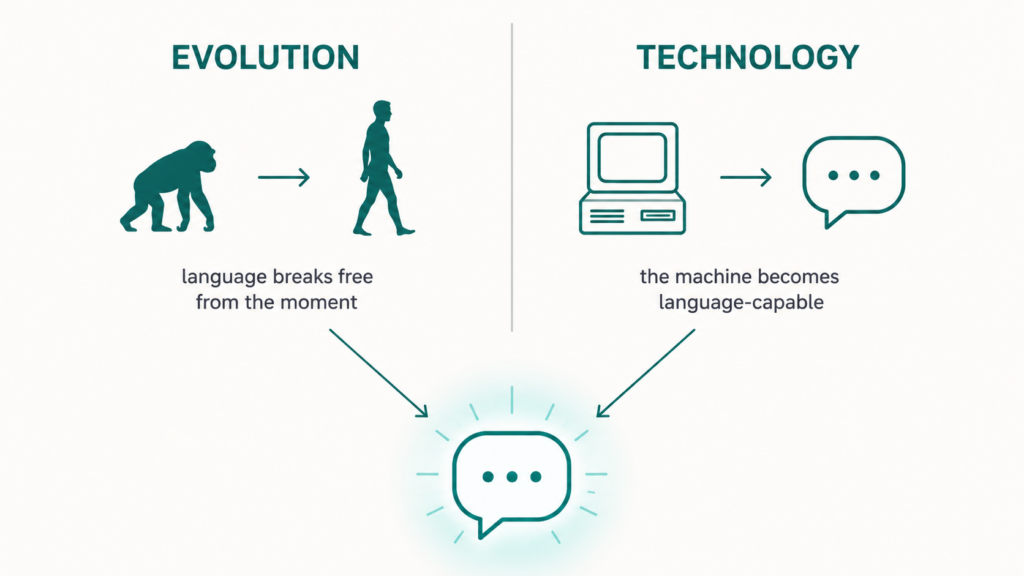
The line of reasoning is elegant. Animals do have a form of language — but they are appeals: warning calls, expressions of joy or danger, bound to the immediate situation. What animals lack is language in the human sense: the ability to sit down in the evening and reflect on what went wrong yesterday and what needs to be planned for the day after tomorrow. This detachment of language from the situation — the capacity for reflection, planning, and the transmission of knowledge — is the real leap in human evolution.
The bold conclusion, as Warnke and kindred authors would argue: the step from the classical computer to the language model is a leap of comparable cultural magnitude to the one from ape to human. Not because the machine made an IQ jump — it didn’t. But because it became language-capable in the reflexive sense. Just as the transition to language upended human civilization without any categorical change in neural hardware, machine language capability changes everything — entirely without “genuine intelligence” being present.
This is the bridge across Marlene’s contradiction. The skeptic is right: the machine does not understand, it has no world, it halluccinates by design. And at the same time, the optimist is right: the paragraph about the Viennese coffeehouse was brilliant, and the tool that wrote it is already changing Marlene’s profession today. Both are true — because the breakthrough is a linguistic one, and language as a tool of reflection and coordination already suffices to produce real effects. You don’t need to think in order to be useful. You need to command language.
This shift decouples two questions that had previously been fused. The speculative question — whether autonomous intelligence will ever arrive and the trillion-dollar bet will pay off — remains open. The practical question — whether AI is already changing the economy today — has already been answered with a clear yes.
The Trillion-Dollar Bet
Let us leave philosophy and follow the money. This is where things get concrete — and where the abstract argument shifts into a very tangible one: is the bet going to pay off?
The starting observation from a capital markets perspective is soberly stark. The gigantic investments in AI — chips, data centers, energy, model training — and the astronomical stock market valuations of the companies involved only make economic sense under one condition: that AI is not merely a useful assistant that makes people faster, but a substitute that replaces entire occupational categories. A good productivity tool doesn’t justify trillion-dollar valuations. A machine that thinks, plans, and acts autonomously does.
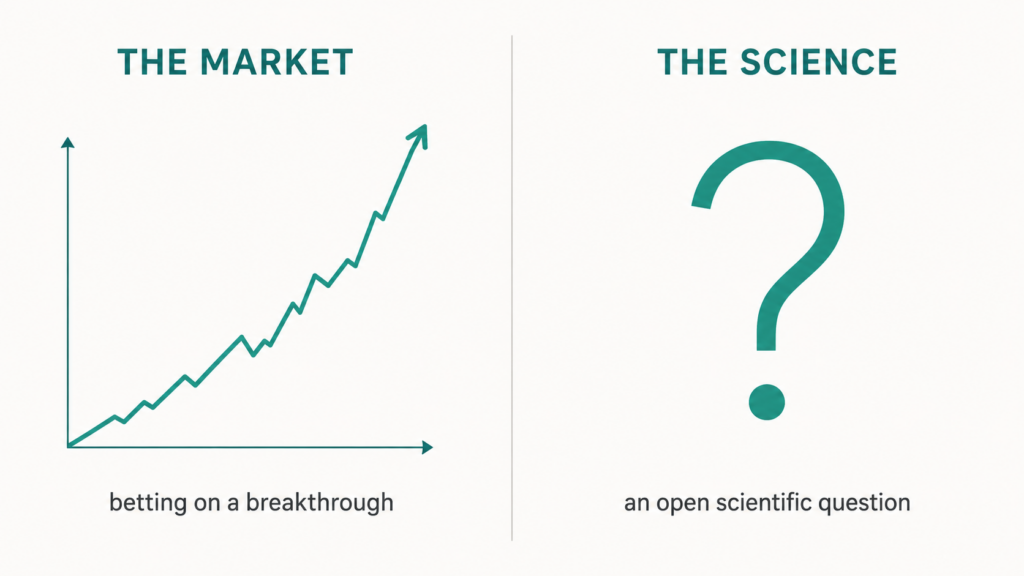
But that substitution presupposes exactly the leap that the skeptics consider impossible: the transition from statistical pattern recognition to genuine reasoning. Experts call this the already-mentioned hope for emergence. The punchline is razor-sharp: the stock market has already factually answered this question by betting on emergence. Science has not answered it. This gap between capital market expectations and scientific uncertainty is the real risk.
We’ve Seen This Before
It is worth recalling IBM Watson, marketed just over a decade ago as a revolutionary AI that would deliver cancer diagnoses and legal analyses. Billions flowed; expectations were enormous. Today, almost no one mentions it anymore. The history of AI is a history of hype cycles: each generation of neural networks was celebrated as the definitive breakthrough. That doesn’t rule out things being different this time. But it obliges us to skepticism.
There is also a structural warning signal: whether the enormous investments can be covered by profits in the long term remains disputed. The running inference costs — the energy and computing overhead of every single user request — are enormous and currently barely covered by revenue. The leading providers are burning capital in anticipation of future monopoly profits. It is notable, meanwhile, that investors are currently building almost nothing but data centers — possibly the next bubble. Behind this lies a physical bottleneck that was long underestimated: energy. Operating large models requires electricity on the scale of mid-sized industrial cities. Energy thus ties together ecological critique, the bubble question, and geopolitics into a single knot.
Growth Story or Fight for Survival?
Instructive here is a distinction that is almost always missing from the public debate. There are two entirely different economic readings of AI — and both have good arguments behind them.
Thesis A: The Next Big Thing. AI is the next great platform phenomenon. In every domain — medicine, law, programming — a dominant provider emerges that, thanks to network effects and data advantages, reaps monopoly-like profits, just as Google and Amazon did in the internet age. If this is true, today’s valuations are not too high — they may be too low. This reading, however, presupposes exactly the substitution — and thus the emergence leap — that the skeptics contest.
Thesis B: Fight for Survival in the Digital Economy. This reading is counterintuitive — and all the more interesting for it. It begins with what digitization did to analogue goods: once a book, a song, a film existed digitally, its value fell because it became infinitely copyable. Digitization equals commoditization equals loss of per-unit value. Spotify made every individual song cheaper because all music is available at any time.
And now AI is directing the same mechanism at digital content itself. A YouTube video that takes a human a week to make, AI generates a thousand times over in a second. Books arise in a day rather than years. But the entire business model of today’s internet — search engines, the content economy, online advertising — rests on the scarcity of high-quality content. When AI now spews out unlimited quantities of plausibly written text and images, the algorithms that once separated the relevant from the irrelevant become dysfunctional. Search results overflow.
In this reading, Google, Microsoft, and Meta are not investing in AI out of growth greed but because they have no choice: whoever doesn’t master the technology themselves will have their existing business model destroyed by others. The billions are flowing into a defensive battle. And the bitter consequence: even if AI succeeds technically in full, high returns need not follow — because all competitors have the same tools and compete away each other’s profits.
Both theses are possible, and the economic future of AI depends not least on which one prevails. What can already be established, though, is what the turn showed earlier: the real-world utility does not depend on the outcome of this bet. Language as a tool for reflection, coordination, and acceleration already suffices to make work measurably more efficient — entirely without artificial reason. The skeptical diagnosis (no understanding, no world-reference) and the observation of real change are not mutually exclusive. They describe the same phenomenon from two angles.
What’s Actually Changing: A Practical View
Setting aside the open future bet and looking only at what is happening right now, a concrete picture emerges. Here are the most important shifts worth keeping your eye on.
Automation is hitting the middle class for the first time. Unlike previous waves, this one is directed at knowledge work with a linguistic core — writing, translating, researching, programming, documenting. Physical trades like crafts and care work are far less exposed. The decisive question is not whether tasks will disappear, but whether the pace of change is faster than the adaptive capacity of labor markets and education systems.
The speed gap is regulatory. Various surveys suggest that in the US, significantly more jobs have already come into contact with AI assistants than in Europe. The real difference, however, may lie not in the degree of penetration but in the speed of adaptation — which depends on labor law and regulatory frameworks. Where companies can restructure quickly, the transformation unfolds more dynamically. For Europe, the assessment is often pessimistic: while there are providers like Mistral or Aleph Alpha and a lively open-source scene, a frontier-model position comparable to OpenAI, Anthropic, or Google is still lacking — as are energy and hardware at the required scale.
The comeback of the analogue. Here things get culturally interesting — and directly relevant to Marlene from the opening. When AI produces perfect imitations in real time (faked interviews, AI-generated wedding speeches, automatic birthday greetings), the distinguishability of original and fake dissolves. And that is precisely what makes authenticity a scarce good. An in-person talk, a handwritten letter, a face-to-face conversation gain in value — not despite the fact that they can’t be digitally replicated, but because of it. The hard-to-fake becomes the quality signature. The old digitization logic — digital is better because cheaper and more scalable — inverts itself.

Possibly a reindustrialization. This leads to a cautiously optimistic thought: if “everything that can be digitized is under attack from AI,” more value creation might shift back to physical, manufacturing industry — because the hard-to-digitize gains in relative value. That could benefit locations like Germany, Switzerland, or Japan. A caveat applies: much is also eroding in manufacturing right now. But as a macroeconomic mirror image of the “comeback of the analogue,” the idea is instructive.
Human plus AI rather than human or AI. The most interesting question may not be whether the machine replaces the human at all, but: which tasks can neither human alone nor AI alone handle well — only both together? AI is strong at scaling, pattern recognition, and memory. Humans are strong at goal-setting, judgment under uncertainty, accountability, and — precisely — world-reference. In medicine, AI detects subtle anomalies in images more reliably, while diagnosis, patient conversation, and responsibility remain with the doctor. Collaboration competency — the ability to ask good questions, critically evaluate AI outputs, and combine machine judgment with human judgment — could become the central qualification of the coming decades.
What We Know, and What We Don’t
To keep all of this from becoming mush, a clean separation between established finding and open dispute is helpful. This sorting is perhaps the most useful thing to take away from the entire debate.
There is broad agreement that LLMs hallucinate; that they possess no reliable factual model; that they measurably increase productivity in many knowledge occupations; that data and computing power are scarce, power-determining resources; and that energy demand is growing sharply.
No consensus exists, by contrast, on the big questions: whether, when, and by what definition artificial general intelligence (AGI) is achievable; whether genuine reasoning will ever emerge through scaling; whether AI on balance destroys jobs, compensates for them, or merely redistributes them; and whether advanced systems will one day pose a serious control risk. These are not knowledge gaps that will close soon. They are the active research frontiers themselves.
The word AGI itself is an example of the confusion. Depending on the definition, it could never come (if genuine understanding is required), arrive in twenty years (if generalization capability is what’s meant), or already exist in partial domains (if we’re looking purely at the economic replaceability of tasks). Anyone talking about AGI without specifying which of these three meanings they intend is talking past the point.
What Could Work, If It Works
With all the warranted skepticism, it is worth looking at the other side of the bet — because there, where AI works as an instrument of discovery, the grounding problem misses the point entirely. Here the machine need not understand the world; it needs to find structures in enormous data spaces that permit empirically valid predictions. And that it can do.
AlphaFold was only the beginning. In materials science, models propose new compounds before they have ever existed in a laboratory — candidates for better batteries, catalysts, or superconductors that human heuristics would scarcely have found. In medicine, AI is drastically shortening the drug discovery process and unlocking connections in genomic and clinical data that would take human teams years. In climate research, learning models deliver weather forecasts and simulations that surpass classical methods in speed and sometimes in accuracy. In fundamental science and mathematics, systems are becoming search beacons in solution spaces that would overwhelm any individual researcher.
This is no longer a parrot — and it does not depend on the outcome of the emergence question. These tools are useful right now, regardless of whether the machine ever “really” thinks. If even a fraction of these lines holds what it promises, AI could become the most productive scientific assistant humanity has ever had: not as a replacement for the inquiring mind, but as its amplifier.
An Open Ending
Let us return to Marlene. She has deleted her invented coffeehouse, kept the rest of the text, and is one experience richer. She now knows that the machine that just amazed her understands nothing — and that this is less relevant to her work than she had thought. AI makes her faster. It does not make her redundant, as long as someone can still spot the invented coffeehouse. The only question is how long that capacity for detection will itself remain scarce — and thus valuable.
Perhaps that is the real shift we are living through: the all-deciding question is no longer “Does the machine think?” That question is fascinating, but may be practically inconsequential for our daily lives. The more productive question is: “What does it change in reality — right now, entirely independent of the answer to the first?” That is precisely what the turn reading is aimed at: the breakthrough lies in the acquisition of language, not in the acquisition of intelligence — and language already suffices to change the world. A strong thesis, no consensus; but one that focuses the gaze on what matters.
And to that, a final, more uncomfortable question attaches itself. If what can be effortlessly reproduced loses value and what is hard to fake gains it — the personal conversation, the physical presence, the original with a history — then AI ultimately poses a very old question in new sharpness: what in what we do is actually irreplaceable? What remains when you strip away everything that can be generated a thousandfold in a second?
Perhaps that is exactly the most valuable side effect of this entire upheaval: that it forces us to finally take that question seriously.
References and Sources
Primary Sources
- Martin Warnke: Large Language Kabbala. Eine kleine Geschichte der Großen Sprachmodelle. Matthes & Seitz Berlin (series “Fröhliche Wissenschaft,” vol. 265), January 2026, 152 pp., ISBN 978-3-7518-3060-7.
- Emily M. Bender, Timnit Gebru et al.: On the Dangers of Stochastic Parrots: Can Language Models Be Too Big? In: Proceedings of FAccT 2021.
Further Positions
- Markus Gabriel: Der Sinn des Denkens. Ullstein, Berlin 2018, on the thesis that machine computation does not replicate human thought. Current and fully AI-focused: Ethische Intelligenz. Wie uns KI moralisch weiterbringen kann. Ullstein, Berlin 2026.
- Yann LeCun: A Path Towards Autonomous Machine Intelligence (2022), on the world-model position.
- John Jumper et al. (Google DeepMind): Highly accurate protein structure prediction with AlphaFold. In: Nature 596 (2021).
FOUNDIC.org is ad-free and has no paywall. If you got something out of this article:  Treat us to a coffee