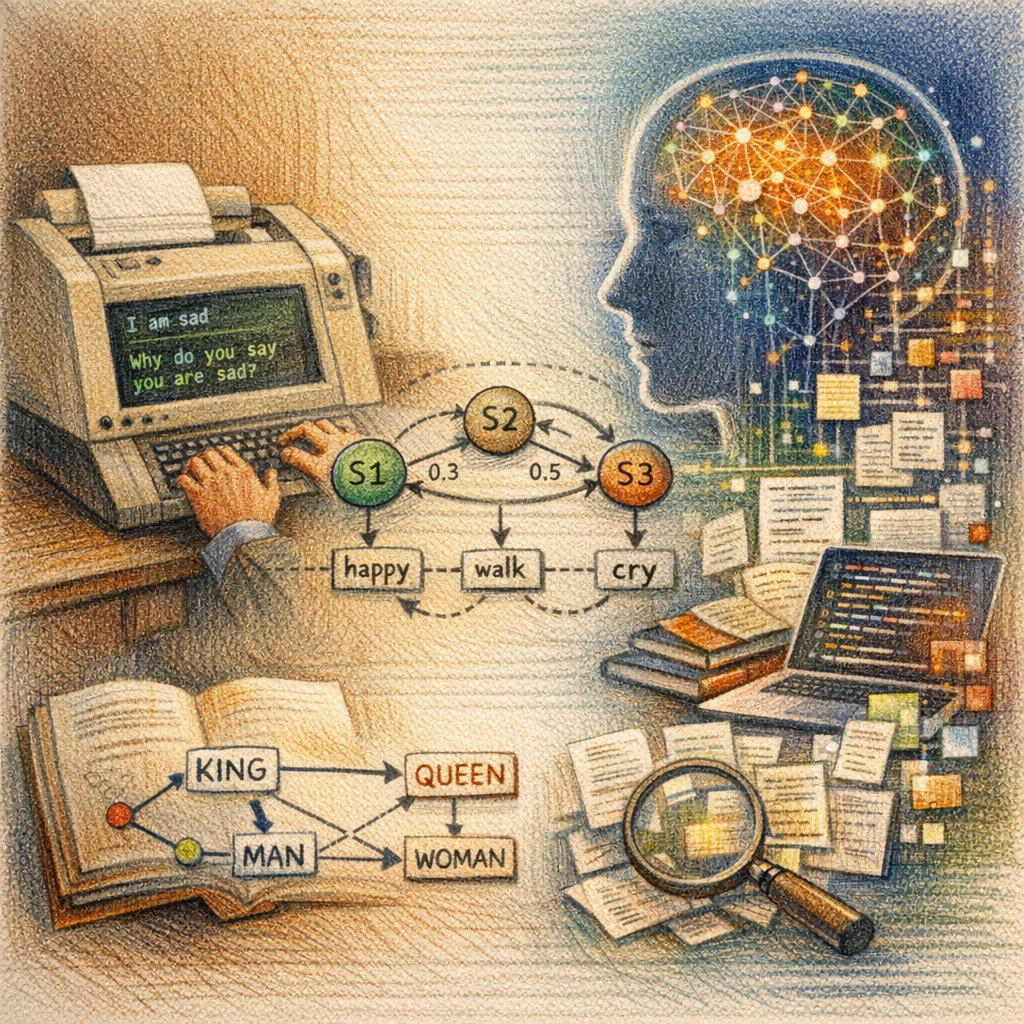
Imagine sitting in the 1960s in front of a bulky teletype machine. You type: “I am sad.” The machine rattles and responds: “Why do you say that you are sad?” Magic? No — just text fragments following a fixed recipe. Today we hold philosophical debates with AI systems that write code, compose poems, and analyze business data. Anyone working with ChatGPT, Claude, or local models in automation workflows often experiences something almost magical: you write a sentence — and get useful answers, summaries, or even working code back. But this magic is the result of a long, surprisingly coherent line of development. Those who understand it make better technical decisions: Which models? Which architecture? When is a prompt enough — and when do you need more? This article traces that line — not as an academic history, but as a practical derivation of why modern Large Language Models (LLMs) work exactly the way they do — and what that means for building a future-proof, AI-capable automation environment.
Why You Should Know This
Whether you’re setting up a RAG system for your company, choosing between GPT-4 and a local Llama, or trying to understand why your chatbot sometimes hallucinates: the answers lie in this line of technical development. Those who know that an LLM “only” calculates probabilities ask different (better) questions. Those who understand why RAG works can use it deliberately. Those who grasp decoding can control outputs. The following 60 years of development history are not an academic finger exercise — they are the key to practical decisions you need to make today.
What an LLM Really Is Technically
Large language models can be soberly described as probabilistic text generators. They calculate — step by step — the probability of the next token (smallest text units, often word fragments) and build an output from that. The dominant architecture today is based on Transformer models. The path from input to answer can be told as a story in four acts — from raw text to seemingly intelligent output. Each of these steps carries the legacy of decades of research. Let’s look at how we got here.
The Stone Age: When Chatbots Still Worked by Recipe
1966: ELIZA – The Parrot Without Memory
In the early days, AI was pure rule-following. The most prominent example is ELIZA, developed at MIT. It worked like a mirror: it searched for keywords and bent sentences according to fixed patterns. The principle: if “mother” appears, respond: “Tell me more about your family.” The problem: there was no real language understanding. ELIZA didn’t know what a “mother” was; it only saw a character string. No statistics, no semantics, no world model.

Why this still mattered: text already had to be segmented — a primitive form of what we call tokenization today. And there was already a form of “answer generation,” however extremely fragile. ELIZA showed: language interaction was possible, but with the depth of a magic trick.
The Era of Probability: Rolling Dice Systematically
Late 1960s to 1990s: Hidden Markov Models – The Foundation Is Laid
From the 1970s through the 90s, things became more mathematical. Researchers understood that language is a process where one thing follows another. This is where Hidden Markov Models (HMMs) enter the scene. HMMs assume that behind what we see (words) lies a hidden state (grammar or intent). An HMM tries to do three things:
- Evaluation: Wie wahrscheinlich ist diese Wortfolge?
- Decoding: Was ist der wahrscheinlichste Weg durch den Satz?
- Training: Wie passe ich meine internen Regeln an die Daten an?
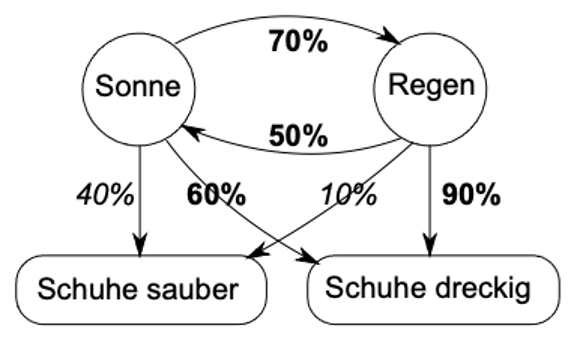
Why this is the direct predecessor of modern LLMs: here the foundation was laid — we no longer view language as a rigid rule, but as a chain of probabilities. Sequences are explained probabilistically. There is a clear separation between “calculating distributions” and “choosing a concrete output.” The idea of decoding (e.g. through the Viterbi algorithm) — the question of how to find the best concrete answer from probabilities — lives on to this day. Anyone who wants to predict the “next word” must be able to calculate.
Der Durchbruch: Wenn Wörter zu Landkarten werden
2013: Word2Vec – The Vector Revolution
For a long time, computers understood words as isolated symbols. “Dog” and “puppy” were as different to it as “dog” and “refrigerator.” That changed in 2013 with Word2Vec and the concept of embeddings. Words were translated into huge, multi-dimensional coordinate systems (vectors). Suddenly concepts had a position in space — and thus a computable meaning.
The famous formula: “King – Man + Woman ≈ Queen” actually worked in vector space.
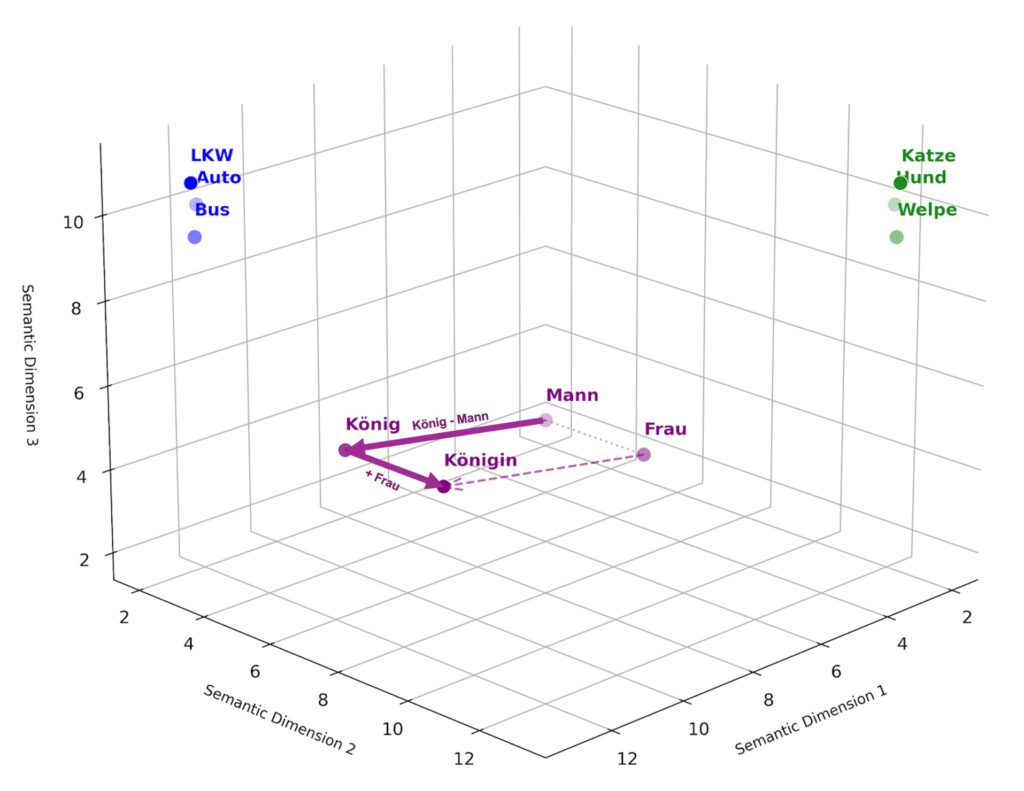
Why this was a milestone:
- Diskrete Symbole wurden kontinuierlich
- Semantische Nähe wurde messbar
- Neuronale Netze konnten Sprache erstmals robust verarbeiten
- Erst durch diese mathematische „Nachbarschaft” konnten KI-Modelle semantische Ähnlichkeiten verstehen, ohne dass ein Mensch sie explizit programmieren musste
Das war die Geburtsstunde des ersten Akts moderner LLMs: Text wird nicht mehr als Buchstabenfolge behandelt, sondern als Position in einem Bedeutungsraum.
2015/2016: Subword Tokenization – The Lego Principle for Language
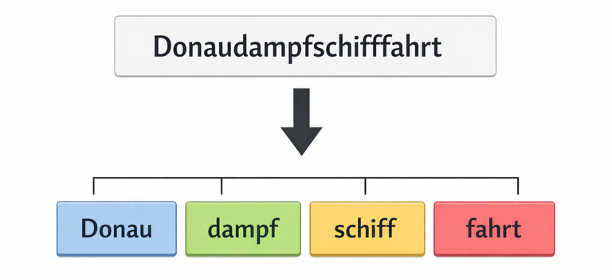
In parallel, subword tokenization (via techniques like Byte-Pair Encoding) solved an old problem: instead of learning every word individually, words are broken into pieces. This allows AI to understand even new coinages like “supercalifragilisticexpialidocious” by recognizing its components. It solved practical problems: open vocabularies, compound words, numbers, technical terms.
The Transformer Revolution: Attention Is Everything
2017: “Attention Is All You Need” – The Real Turning Point
In 2017, a paper appeared with the bold title “Attention Is All You Need.” It introduced the Transformer (the “T” in GPT). The innovation? Self-attention. Earlier models laboriously read sentences from left to right and often “forgot” the beginning when it was too long. The Transformer, on the other hand, looks at the entire text simultaneously and weights which words are important for each other. Example: In the sentence “The bank was a relief after the long march,” the AI recognizes through attention that “bank” refers to a bench (because of “march” and “relief”) and not a financial institution.
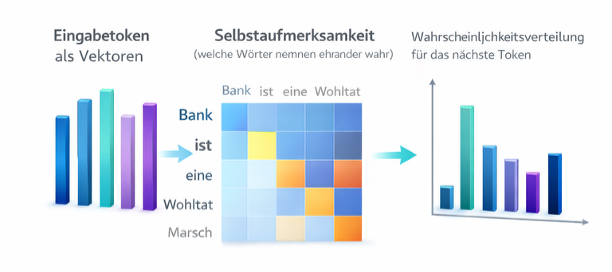
The consequences:
- Massive Parallelisierung möglich
- Lange Kontexte werden beherrschbar
- Skalierung wird praktikabel
- Alles kann gleichzeitig betrachtet werden – kein mühsamer Schritt-für-Schritt-Durchlauf mehr
Das ist der zweite Akt: Das Modell verarbeitet Bedeutungen und berechnet Zusammenhänge. Es erstellt eine Wahrscheinlichkeitsverteilung über zigtausende möglicher nächster Tokens.
Three Common Misconceptions – Clarified
Before we continue, it’s worth correcting three persistent misconceptions about LLMs: ❌ “The model really understands me” ✅ It calculates probabilities based on patterns. Very good patterns — but no consciousness. The “map” from vectors is not semantic understanding in the human sense, but statistical proximity. ❌ “Bigger is always better” ✅ A small model + RAG + good prompts often beats a large model without context. GPT-4 without access to your data is less useful than Llama-2 with perfectly prepared company documents. ❌ “Hallucinations are a bug” ✅ They are a feature: the model fills probability gaps. It was trained to always generate something. RAG turns this into a controllable process by providing real facts as anchors.
2020: GPT-3 and In-Context Learning – The Aha Moment
Large models suddenly showed: you can explain tasks in the prompt without retraining the model. Give a few examples — and the model learns “on the fly.” This is not consciousness. It’s statistics at large scale. But it feels magical.
From Chatterbox to Assistant: The Psychological Fine-Tuning
Instruction Tuning – When AI Learns What You Really Want
A pure language model like GPT-3 was initially just an extremely good text completer. If you asked: “How do I bake a cake?”, it might respond: “How do I bake a loaf? How do I bake cookies?” — because it thought you wanted to complete a list of book titles. A base model implicitly answers: “What comes next?” Users ask: “Please do X — under my conditions.” Instruction tuning closes this gap. Through Supervised Fine-Tuning and Reinforcement Learning from Human Feedback (RLHF), responses that seem helpful, correct, and cooperative become more probable. Humans rated the AI’s answers, and a reward model taught it to be more helpful, more polite, and less “hallucinatory.” ChatGPT was born.
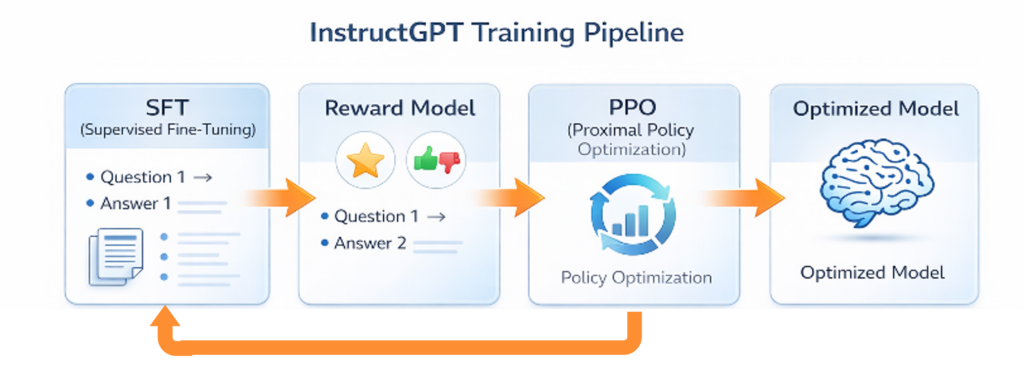
This is the third act: the model learns not just “what is statistically probable,” but “what does the human really want to hear.” The architecture remains the same — but the probabilities shift toward usefulness.
The Present: RAG – Knowledge Without Guessing
When the Model Looks Up Instead of Hallucinating
Despite all their intelligence, LLMs have a problem: their knowledge is “frozen” (at the training cutoff) and they tend to make things up when they don’t know the answer precisely. This is where RAG (Retrieval-Augmented Generation) comes in — the current gold-standard pattern for enterprises. Think of RAG like an “open-book exam”:
- Die KI bekommt eine Frage
- Sie sucht in Ihren eigenen Daten (PDFs, Datenbanken, Wikis) nach relevanten Stellen – über Embeddings, also Vektorsuche
- Sie bekommt diese Textstellen als Kontext geliefert
- Sie formuliert die Antwort nur basierend auf diesen Fakten
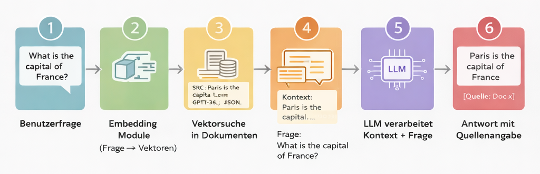
In practice this means:
- Dokumente werden segmentiert
- Embeddings werden berechnet
- In einem Vektorindex gespeichert (etwa ChromaDB, Weaviate)
- Zur Laufzeit wird relevanter Kontext gesucht
- Dem Prompt hinzugefügt
Das LLM verarbeitet dann konkrete Quellen, statt zu halluzinieren. Das macht die KI verlässlich, aktuell und vor allem: Sie „erfindet” deutlich seltener Fakten, da sie eine Quelle zum Nachschlagen hat.
How an LLM Works: Four Steps from Text to Intelligence
Everything we admire in AI today can be reduced to four functional steps that carry the legacy of the last 60 years. Each step answers a fundamental question on the path from raw text to a useful answer.
1. Understanding: Text Becomes Meaning
The question: How does the model turn letters into something it can calculate with? The solution: Tokenization + Embeddings Text is broken down (from ELIZA’s keyword tricks to modern subword logic) and translated into a multi-dimensional space of meaning. “King” and “Queen” are closer together than “King” and “Bread” — the model “understands” semantic proximity. Historical roots:
- ELIZA (1966): Primitive Textsegmentierung
- Word2Vec (2013): Vektoren statt Symbole
- Subword-Tokenisierung (2015): Lego-Prinzip für offene Vokabulare
Ergebnis: Jedes Token ist jetzt ein Vektor – eine Position im Bedeutungsraum. Das Modell kann mit Konzepten rechnen.
2. Thinking: The Transformer Calculates Relationships
The question: How does the model recognize which words are important for each other? The solution: Self-Attention in the Transformer The model looks at all words simultaneously and weights: what is relevant to what? In “The bank was a relief after the march,” it recognizes: bank = seating, not financial institution. Historical roots:
- Hidden-Markov-Modelle (1970er–90er): Sequenzen als Wahrscheinlichkeitsketten
- Transformer (2017): Self-Attention ersetzt sequenzielle Verarbeitung
- Skalierung (2020+): GPT-3 zeigt, was große Modelle können
Ergebnis: Eine Wahrscheinlichkeitsverteilung über 50.000+ mögliche nächste Tokens. Für jedes Token: „Wie wahrscheinlich passt es hier?”
3. Choosing: From Probability to Text
The question: How does “Token A: 23%, Token B: 19%, Token C: 15%” become a concrete word? The solution: Decoding strategies The model has calculated probabilities — but which token do we actually choose?
- Greedy: Nimm immer das wahrscheinlichste (langweilig, aber sicher)
- Beam Search: Behalte mehrere Pfade parallel und wähle den besten Gesamtpfad
- Top-k Sampling: Wähle zufällig aus den k wahrscheinlichsten Tokens
- Top-p (Nucleus): Würfle gewichtet aus den wahrscheinlichsten Tokens, bis ihre Summe p% erreicht (kreativer, aber riskanter)
Historische Wurzeln: - Viterbi-Algorithmus (1980er): Beste Pfade durch Wahrscheinlichkeitsräume
- Beam Search: Aus der maschinellen Übersetzung
- Sampling-Strategien: Balance zwischen Kreativität und Kohärenz
Ergebnis: Ein konkretes Token. Wiederhole den Prozess, bis ein Satz entsteht.
Gleiche Gewichte, andere Strategie – völlig andere Qualität. Die Dekodierung entscheidet, ob Ihre Antwort kreativ oder konservativ, flüssig oder repetitiv wird.
4. Optimizing: From Parrot to Assistant
The question: How does the model learn to give helpful rather than just probable answers? The solution: Instruction Tuning & RLHF The model learns not just “what comes statistically next,” but “what does the human actually want to hear.” Humans rate answers → a reward model shifts probabilities toward “helpful, correct, cooperative.” Historical roots:
- Supervised Fine-Tuning: Trainieren auf Frage-Antwort-Paaren
- RLHF (2022): InstructGPT/ChatGPT lernen aus menschlichem Feedback
- Constitutional AI: Modelle lernen Prinzipien statt nur Beispiele
Ergebnis: Ein System, das tut, was Sie wollen – nicht nur, was statistisch auf Ihre Eingabe folgen würde. Die Architektur bleibt identisch, aber der Wahrscheinlichkeitsraum ist anders kalibriert.
What This Concretely Means for Your Architecture Decisions
The theory is one thing — but what practical decisions follow? Here are three typical scenarios:
Example 1: Model Selection – GPT-4 or Local Llama?
You’re considering whether to use cloud models or local open-source solutions? What you now understand:
- Beide nutzen die gleichen vier Prinzipien (Verstehen → Denken → Wählen → Optimieren)
- Der Unterschied liegt primär in Trainingsdaten (Menge und Qualität) und Optimierung (Wie viel RLHF-Budget wurde investiert?)
- Entscheidend ist: Ein kleines lokales Modell + perfekt aufbereitetes RAG kann präziser sein als GPT-4 ohne Kontext zu Ihren Daten
Praktische Konsequenz:
Wenn Sie Datenhoheit brauchen und domänenspezifische Aufgaben haben, ist Llama-2 (13B) + RAG oft besser als GPT-4 ohne Ihre Wissensbasis.
Example 2: Prompt Engineering – Why Does “Think Step by Step” Work So Well?
You’ve noticed that “Think step by step” or “Explain your reasoning” massively improves answer quality? What you now understand:
- Dekodierung bevorzugt wahrscheinliche Fortsetzungen
- „Schritt für Schritt” triggert strukturierte Reasoning-Patterns aus dem Training (Chain-of-Thought)
- Das ist kein Trick – sondern bewusste Nutzung der Wahrscheinlichkeitsverteilung: Sie lenken das Modell in einen Bereich des Vektorraums, wo sorgfältige Analysen wahrscheinlicher sind
Praktische Konsequenz:
Ihre Prompts sind keine Magie, sondern Wahrscheinlichkeits-Steuerung. Je besser Sie verstehen, was während des Trainings (Schritt 4: Optimieren) gelernt wurde, desto präziser können Sie promten.
Example 3: Reducing Hallucinations – Three Technical Levers
Your system sometimes invents facts. You want to minimize that? What you now understand: Lever 1 – Temperature (Decoding):
- Niedrige Temperature (z.B. 0.2) = konservativere Token-Wahl
- Das Modell bleibt näher an hochwahrscheinlichen Fortsetzungen
- Einsatz: Für faktische Aufgaben wie Datenextraktion
Hebel 2 – RAG (Kontext): - Liefern Sie dem Modell echte Quellen im Prompt
- Das verschiebt die Wahrscheinlichkeitsverteilung weg von „ich rate mal” hin zu „ich paraphrasiere die Quelle”
- Einsatz: Für wissensintensive Aufgaben (Support, Recherche)
Hebel 3 – System-Prompts (Optimierung): - „Antworte nur auf Basis der bereitgestellten Quellen. Wenn unsicher, sage: Ich weiß es nicht.”
- Nutzt die RLHF-Kalibrierung: Das Modell wurde trainiert, Anweisungen zu befolgen
- Einsatz: In Kombination mit RAG für maximale Verlässlichkeit
Praktische Konsequenz:
Sie brauchen nicht ein perfekteres Modell – Sie brauchen die richtige Kombination aus Dekodierung, Kontext und Instruktion.
A Clear Decision: What Does This Mean for Today’s Systems?
The democratization of this technology means that today you no longer need billion-dollar infrastructure to build your own, secure AI environments. LLMs are not black-box magic, but precise functional chains with traceable mechanisms:
- Verstehen macht Text berechenbar (Embeddings)
- Denken berechnet Zusammenhänge (Transformer)
- Wählen produziert konkrete Ausgaben (Dekodierung)
- Optimieren macht Ausgaben nützlich (Instruction Tuning)
- RAG macht das System verlässlich und aktuell (externe Wissensbasis)
Wer heute eine zukunftssichere, KI-fähige Automatisierungsumgebung aufbaut, sollte genau hier ansetzen: bei der bewussten Kombination aus Modell, Kontext, Dekodierung und Evaluation.
Mit RAG können Sie Ihre Datenhoheit behalten und dennoch modernste Automatisierung nutzen. Open-Source-Modelle lassen sich lokal betreiben, ohne Ihre Daten in die Cloud zu schicken.
Qualität entsteht nicht nur im Modell, sondern im Systemdesign.
Nicht spektakulär. Aber sehr wirksam.
The path from rigid rules to probabilistic wonders was not a sudden flash of inspiration, but a fascinating technical lineage. Those who understand it can not only comprehend today’s AI revolution — they can harness it for their own business.