Notice: This article was created with AI.
What’s It About?
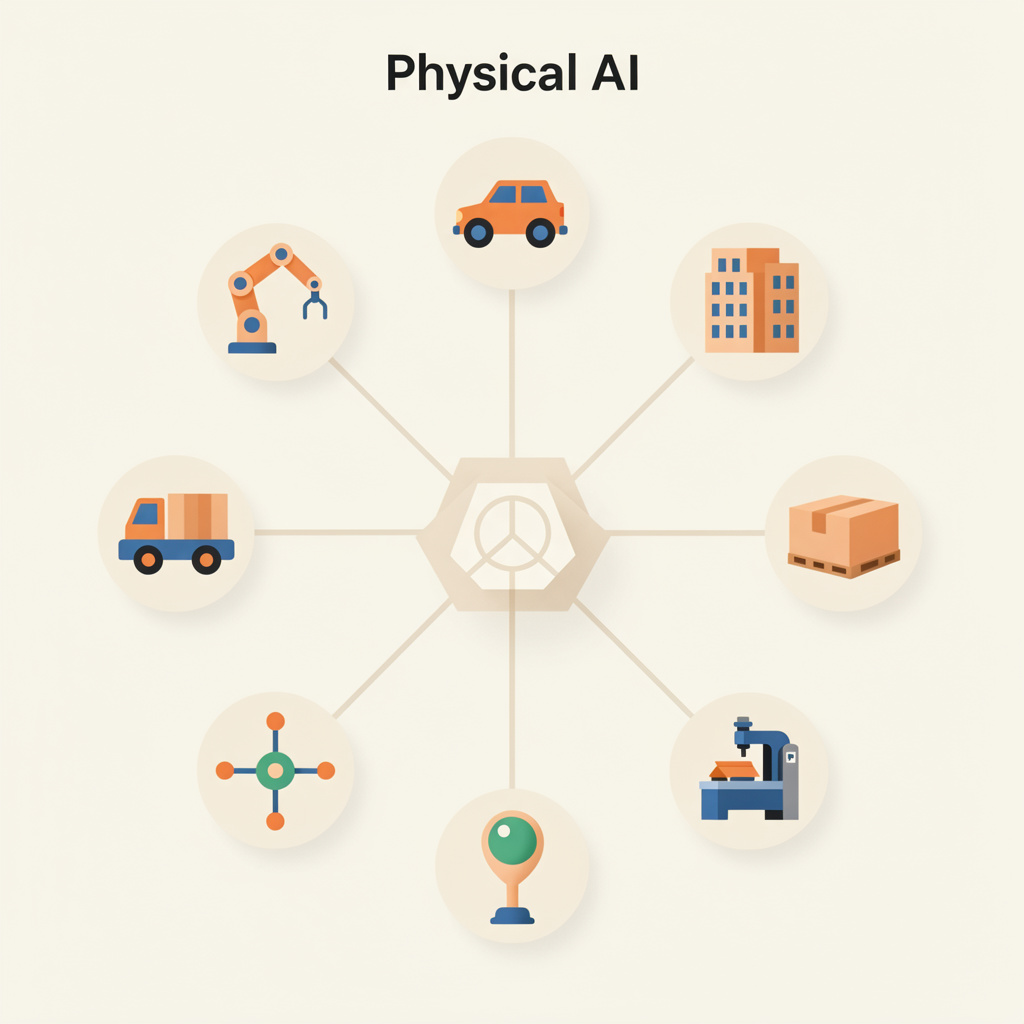
Physical AI describes the combination of artificial intelligence with physical machines and robots that act independently in the real world. Unlike purely digital AI systems, these technologies can perceive their environment, interpret it, and act accordingly. From manufacturing and logistics to smart cities, physical AI opens up a broad spectrum of possible applications.
The market for this technology shows enormous growth potential: while the volume currently stands at around 92 billion dollars, analysts forecast a rise to more than 489 billion dollars by 2030. Companies are already relying on intelligent systems today to increase efficiency and establish new safety standards.
Background & Context
The merging of AI software with mechanical systems enables entirely new levels of automation. In industrial production, robots are taking on increasingly complex tasks: BMW, for example, is relying on physical AI with the humanoid robot Figure 03 to support assembly work. Such systems can not only execute pre-programmed movements but also learn from their environment and adapt flexibly.
Physical AI is also revolutionizing established processes in quality assurance. Camera-based systems automatically identify production defects and enable predictive maintenance before costly failures arise. In logistics, intelligent algorithms coordinate autonomous vehicles and drones for efficient goods transport while at the same time optimizing routes and avoiding collisions.
Beyond this, physical AI finds application in building automation and urban infrastructure. Intelligent building systems control heating, ventilation, and security technology according to demand and thus lower operating costs. In smart cities, traffic flows are optimized through networked sensors and AI-controlled traffic light systems, which reduces congestion and improves quality of life.
What Does This Mean?
- Productivity leap in industry: Physical AI enables manufacturing companies to achieve higher precision and flexibility while error rates simultaneously fall.
- New safety standards: Camera-based monitoring systems with AI evaluation respond faster to hazardous situations and relieve security personnel.
- Logistics revolution: Autonomous transport systems in warehouses and on the last mile considerably reduce delivery times and personnel costs.
- Energy efficiency: Intelligent buildings and infrastructures optimize resource consumption and contribute to climate targets.
- Economic potential: The forecast market growth to almost 500 billion dollars signals massive investment and innovation opportunities.
Sources
7 Anwendungsfälle für Physical AI (Computerwoche)
BMW Group setzt erstmals humanoide Roboter in der Produktion in Deutschland ein (BMW Group)
BMW testet humanoide Roboter in Leipzig (CIO)
Physical AI: Künstliche Intelligenz in der Robotik (Innok Robotics)
This article was created with AI assistance and is based on the listed sources as well as the language model’s training data.
Further Reading: Paperclip: When AI Agents Get an Org Chart